




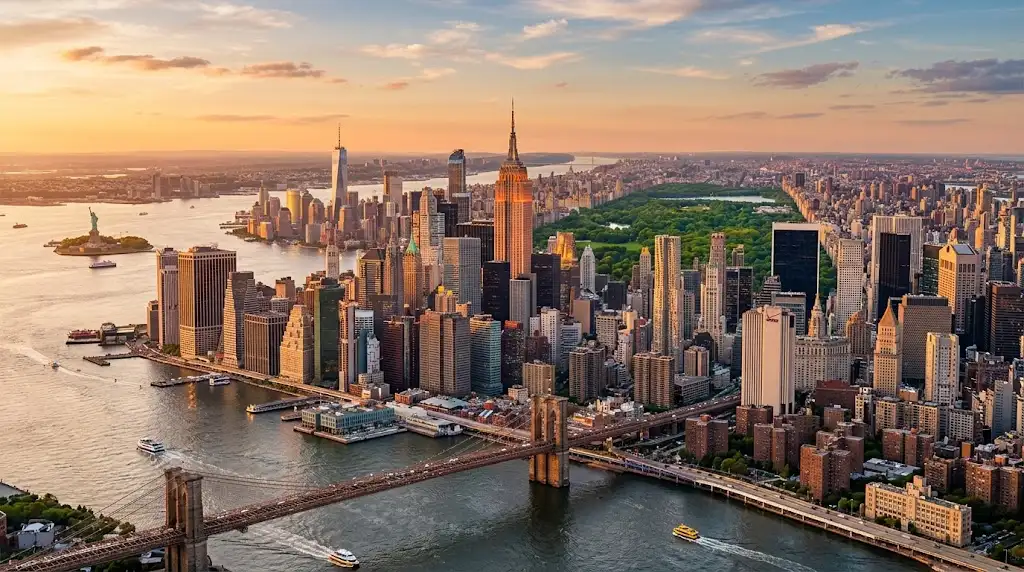
This guide explores the most popular places to visit in New York City, including classic Manhattan attractions, cultural institutions, scenic locations, family-friendly destinations, and places worth exploring beyond the most crowded tourist areas.
New York City welcomed approximately 65 million visitors in 2025, demonstrating the continued strength of its tourism industry. For 2026, the city’s tourism organization projects approximately 66.3 million visitors. That popularity reflects the city’s extraordinary mix of landmarks, entertainment, food, culture, shopping, and neighborhood experiences.
Why New York City Is Such a Popular Travel Destination
New York City combines several types of travel experiences in one metropolitan destination. A visitor can begin the morning in Central Park, explore a museum before lunch, walk across a historic bridge in the afternoon, watch a Broadway show in the evening, and finish the night surrounded by the lights of Midtown.
The city also consists of five boroughs—Manhattan, Brooklyn, Queens, the Bronx, and Staten Island—each with its own neighborhoods, attractions, food traditions, cultural institutions, and personality.
Manhattan contains many of the attractions most commonly associated with New York, but travelers who venture beyond Manhattan can discover another side of the city.
If you enjoy building destination lists before traveling, you can also explore our broader travel bucket list ideas for inspiration beyond New York.
1. Central Park
Central Park is one of the first places most visitors should consider adding to a New York itinerary. Stretching across 843 acres in the heart of Manhattan, the park provides a remarkable contrast to the surrounding skyscrapers and busy avenues.
Visitors can walk along tree-lined paths, relax beside the lake, explore bridges and gardens, rent a boat, visit the Central Park Zoo, or simply find a quiet area away from the city’s traffic.
Central Park works for almost every type of traveler. Families can spend hours exploring its recreational areas, couples can enjoy scenic walks, and photographers can find countless city-and-nature compositions.
It is also one of the easiest attractions to combine with other major destinations because several famous museums and Upper East and Upper West Side neighborhoods are located nearby.
2. Times Square
Few places represent the energy of New York City more vividly than Times Square.
Located around Broadway and 42nd Street, Times Square is famous for enormous digital billboards, illuminated buildings, theaters, restaurants, stores, and constant pedestrian activity.
The area can feel overwhelming during busy periods, but that intensity is part of its character. Visiting after dark is particularly memorable because the illuminated signs transform the area into one of the brightest urban environments in the world.
Times Square is also an ideal starting point for exploring the nearby Theater District and Broadway.
3. Statue of Liberty and Liberty Island
The Statue of Liberty remains one of America’s most recognizable symbols and one of the most popular attractions for international visitors.
The monument stands on Liberty Island in New York Harbor and can be experienced through ferry trips, island exploration, museum visits, and eligible monument or pedestal access.
Even travelers who do not plan to spend an entire day at the attraction can appreciate the Statue of Liberty from the water. Ferry rides provide impressive views of Lower Manhattan, the harbor, and the surrounding skyline.
Because the attraction can become busy, travelers should research ticketing and ferry arrangements before arriving.
4. Empire State Building
The Empire State Building is another defining feature of the Manhattan skyline.
Located on Fifth Avenue, the Art Deco skyscraper has been one of New York’s most recognizable landmarks for generations. Its observation decks provide panoramic views across Manhattan and beyond.
For photographers, sunrise and sunset can be especially attractive times to experience New York from above. Nighttime also offers a completely different perspective as the city’s lights spread across the horizon.
The Empire State Building is located close to major shopping and transportation areas, making it relatively easy to combine with other Midtown attractions.
5. Grand Central Terminal
Grand Central Terminal is more than a transportation hub. Its monumental architecture, historic interior, famous celestial ceiling, and central Midtown location make it a destination in its own right.
Visitors can admire the Main Concourse, explore architectural details, and experience the constant movement of commuters and travelers.
Its location near Vanderbilt Avenue, Fifth Avenue, Bryant Park, Rockefeller Center, and several observation decks makes Grand Central a useful stop when creating a walking itinerary through Midtown.
6. Brooklyn Bridge
Walking across the Brooklyn Bridge is one of the classic New York experiences.
The bridge connects Manhattan and Brooklyn across the East River and provides memorable views of the skyline, waterfront, and surrounding architecture.
The pedestrian walkway is particularly attractive for visitors who want photographs of Lower Manhattan. Consider walking toward Brooklyn and continuing into DUMBO or Brooklyn Bridge Park afterward.
The experience is especially appealing around sunrise or sunset, although travelers should expect more crowds during popular hours.
7. The Metropolitan Museum of Art
The Metropolitan Museum of Art, commonly called the Met, is one of the world’s most important art museums and a major attraction on Fifth Avenue.
Its collections cover thousands of years of art and include works from numerous cultures and historical periods.
Because the museum is enormous, first-time visitors should avoid trying to see everything. Choosing several galleries or collections in advance can make the experience more enjoyable.
The Met is also part of the Museum Mile area, making it possible to combine the visit with other cultural attractions along Fifth Avenue.
8. American Museum of Natural History
For families and visitors interested in science, nature, anthropology, and the history of the planet, the American Museum of Natural History is one of New York’s standout attractions.
Its exhibits cover subjects ranging from dinosaurs and fossils to human cultures, biodiversity, space, and natural history.
The museum’s location near Central Park makes it particularly convenient to combine with a day exploring the Upper West Side and the park.
9. Rockefeller Center
Rockefeller Center combines architecture, entertainment, shopping, dining, and one of Manhattan’s best-known observation experiences.
The complex is particularly famous during the holiday season when its enormous Christmas tree and ice-skating rink become major seasonal attractions.
At other times of year, visitors can explore the plaza, admire the Art Deco architecture, shop, dine, or visit Top of the Rock for panoramic skyline views.
10. Top of the Rock
For travelers who want a high-level view of Manhattan, Top of the Rock offers a different perspective from the Empire State Building.
One of its major advantages is the opportunity to photograph the Manhattan skyline with the Empire State Building itself visible in the distance.
The observation decks provide views across Central Park, Midtown, and Lower Manhattan depending on visibility and viewing direction.
11. The High Line
The High Line transformed an elevated railway structure on Manhattan’s West Side into a landscaped public park.
The attraction provides an unusual way to explore the city above street level while moving through gardens, public art, architecture, and changing views of Manhattan.
It is particularly convenient to combine with Chelsea Market, Hudson Yards, and the surrounding art-gallery district.
Visitors who enjoy combining major landmarks with neighborhood exploration will often find the High Line more rewarding than simply moving between conventional tourist attractions.
12. Broadway and the Theater District
For entertainment lovers, Broadway is one of the most important reasons to visit New York City.
The Theater District contains numerous Broadway theaters where visitors can experience musicals, dramas, revivals, and major productions featuring performers from around the world.
A Broadway show can be one of the highlights of a New York trip, but planning ahead is useful because popular productions can sell out and ticket prices can vary considerably.
Times Square, Broadway theaters, restaurants, and other Midtown attractions can easily be combined into one evening itinerary.
13. One World Observatory
One World Observatory offers visitors a different way to experience the Manhattan skyline from Lower Manhattan.
The attraction is located at One World Trade Center and provides elevated views across New York Harbor, Manhattan, Brooklyn, and surrounding areas.
Its location also makes it convenient to combine with the 9/11 Memorial & Museum, the Oculus, Battery Park, and other Lower Manhattan attractions.
14. 9/11 Memorial & Museum
The 9/11 Memorial & Museum is one of the most significant historical destinations in Lower Manhattan.
The memorial honors the victims of the September 11 attacks, while the museum presents historical material, artifacts, photographs, and personal stories connected with the events and their aftermath.
This is a more reflective experience than attractions such as Times Square or Broadway, and visitors should allow enough time to explore it thoughtfully.
15. The Museum of Modern Art
The Museum of Modern Art, known as MoMA, is a major destination for visitors interested in modern and contemporary art.
Its collections include influential works across painting, sculpture, photography, film, design, and other forms of artistic expression.
MoMA is located in Midtown Manhattan, making it convenient to pair with Rockefeller Center, Fifth Avenue, St. Patrick’s Cathedral, Times Square, or Central Park.
16. Fifth Avenue
Fifth Avenue is one of New York’s most famous streets and combines shopping, architecture, museums, hotels, churches, and landmarks.
The stretch around Midtown is particularly popular with visitors because it places several attractions within walking distance of one another.
Luxury shopping is another major draw, with internationally recognized fashion houses occupying prominent addresses.
For travelers interested in combining sightseeing and shopping, Fifth Avenue can easily fill several hours of an itinerary.
17. St. Patrick’s Cathedral
St. Patrick’s Cathedral stands opposite Rockefeller Center on Fifth Avenue and provides an impressive example of Gothic Revival architecture in the middle of Midtown.
The cathedral’s elaborate interior and exterior make it an interesting stop even for visitors who are not specifically planning a religious sightseeing experience.
Its location makes it particularly easy to visit while exploring Rockefeller Center, Fifth Avenue, Radio City Music Hall, and nearby attractions.
18. The Flatiron District and Union Square
The Flatiron District offers a different experience from the major tourist zones of Midtown.
The area is known for the distinctive Flatiron Building, historic architecture, restaurants, shops, and proximity to Union Square and Madison Square Park.
It is a good neighborhood for visitors who want to spend time walking rather than moving from one major attraction to another.
19. SoHo
SoHo is one of Manhattan’s most recognizable shopping and architecture districts.
The neighborhood is famous for cast-iron buildings, independent stores, international fashion brands, restaurants, galleries, and attractive streetscapes.
SoHo can easily be combined with Greenwich Village, Chinatown, Little Italy, and Lower Manhattan for a full day of neighborhood exploration.
20. Greenwich Village
Greenwich Village is known for its historic streets, restaurants, cafés, music venues, independent businesses, and distinctive neighborhood atmosphere.
Unlike some of the more monumental attractions in Midtown, the Village is best experienced slowly. Walk its streets, stop for food, explore Washington Square Park, and enjoy the area’s architecture and local character.
This is a particularly good choice for travelers who want to experience New York as a collection of neighborhoods rather than simply a list of landmarks.
21. Chinatown and Little Italy
New York’s Chinatown and Little Italy provide visitors with opportunities to explore food, culture, history, and shopping within a relatively compact area of Lower Manhattan.
Chinatown is particularly well known for restaurants, bakeries, markets, tea shops, and specialty stores, while Little Italy retains a strong connection to Italian-American history and cuisine.
Both neighborhoods can be combined with SoHo, the Lower East Side, and other downtown destinations.
22. Wall Street and the Financial District
The Financial District is another essential stop for first-time visitors.
Wall Street, the New York Stock Exchange area, historic buildings, Federal Hall, Trinity Church, and nearby waterfront locations all contribute to the district’s distinctive character.
The neighborhood also provides easy access to the 9/11 Memorial, One World Trade Center, Battery Park, and ferry terminals.
23. Battery Park
Battery Park sits at the southern tip of Manhattan and provides views toward New York Harbor and the Statue of Liberty.
It can be a pleasant place to slow down after exploring the Financial District, and it also serves as an important access point for harbor and Statue of Liberty-related excursions.
The waterfront setting makes Battery Park especially attractive for travelers who want a break from the dense streets of Lower Manhattan.
24. DUMBO and Brooklyn Bridge Park
Across the East River, DUMBO and Brooklyn Bridge Park offer some of the most recognizable skyline views in Brooklyn.
The area combines historic industrial architecture, restaurants, waterfront paths, green spaces, and spectacular views toward Manhattan.
Walking across the Brooklyn Bridge and then spending time around DUMBO is one of the most effective ways to combine two major experiences into a single itinerary.
25. Coney Island
For a completely different New York experience, head to Coney Island in Brooklyn.
The destination is known for its boardwalk, beach, amusement rides, entertainment, and classic seaside atmosphere.
Coney Island works particularly well for families and travelers visiting during warmer months, although the experience changes considerably with the season.
Best Places to Visit in New York City for Different Travelers
Not every visitor wants the same New York experience. Choosing attractions according to your interests can make your itinerary considerably better.
Best for First-Time Visitors
- Times Square
- Central Park
- Empire State Building
- Statue of Liberty
- Brooklyn Bridge
- Grand Central Terminal
- Rockefeller Center
Best for Families
- Central Park
- American Museum of Natural History
- Statue of Liberty
- Coney Island
- New York Zoo and wildlife attractions
- Broadway family productions
Best for Art and Culture
- The Metropolitan Museum of Art
- MoMA
- American Museum of Natural History
- Guggenheim Museum
- Broadway
- 9/11 Memorial & Museum
Best for Photography
- Brooklyn Bridge
- Top of the Rock
- Empire State Building
- Central Park
- High Line
- DUMBO
- Battery Park
Best for Neighborhood Exploration
- Greenwich Village
- SoHo
- Chinatown
- Little Italy
- DUMBO
- Flatiron District
How Many Days Do You Need in New York City?
There is no perfect number of days for New York because the city contains far more attractions than most visitors can experience in a single trip.
Three days can provide a fast introduction to major Manhattan landmarks.
Four to five days gives travelers more flexibility to combine iconic attractions with museums, neighborhoods, parks, and Brooklyn.
A week or longer allows for a deeper experience that includes several museums, multiple neighborhoods, Brooklyn, Queens, seasonal attractions, food experiences, and less-touristy destinations.
If you have limited time, prioritize attractions according to geography. Visiting several destinations in the same area on the same day can dramatically reduce unnecessary travel.
How to Plan a New York City Sightseeing Itinerary
The best New York itineraries are usually organized by neighborhood rather than by popularity alone.
Example Day 1: Midtown
- Grand Central Terminal
- Rockefeller Center
- St. Patrick’s Cathedral
- Fifth Avenue
- Times Square
- Broadway show
Example Day 2: Central Park and Museums
- Central Park
- American Museum of Natural History
- The Metropolitan Museum of Art
- Upper East Side or Upper West Side
Example Day 3: Lower Manhattan
- Statue of Liberty
- Battery Park
- Wall Street
- 9/11 Memorial & Museum
- One World Observatory
Example Day 4: Brooklyn
- Brooklyn Bridge
- DUMBO
- Brooklyn Bridge Park
- Local Brooklyn neighborhoods
- Coney Island if time and season allow
Best Time to Visit New York City
New York City can be visited throughout the year, but each season creates a different travel experience.
Spring
Spring brings comfortable sightseeing conditions and blooming parks. It can be an excellent season for walking through Central Park, the High Line, and residential neighborhoods.
Summer
Summer offers long daylight hours and many outdoor activities, but temperatures and crowds can make midday sightseeing tiring.
Fall
Autumn is one of the most attractive seasons for walking tours, parks, photography, and neighborhood exploration. Cooler temperatures can also make long sightseeing days more comfortable.
Winter
Winter can be cold, but the holiday season creates a particularly memorable atmosphere around Rockefeller Center, Fifth Avenue, department stores, theaters, and seasonal attractions.
Visitors planning trips beyond New York City can also compare their itinerary with our guide to places to visit in Upstate New York.
Tips for Visiting New York City
Use Public Transportation
New York’s subway and bus network can save significant time compared with driving through Manhattan traffic. Walking is also an important part of the New York experience.
Wear Comfortable Shoes
Even visitors who plan to use public transportation often walk several miles a day. Comfortable footwear can make a major difference.
Group Attractions by Location
Do not plan to visit Central Park, Lower Manhattan, Brooklyn, and the Bronx as though they were next-door attractions. Organizing your days geographically makes the trip more efficient.
Reserve Popular Attractions Ahead
Observation decks, Broadway shows, museums, ferries, and certain special experiences can have limited availability. Check official attraction websites before your trip.
Leave Time for Unplanned Exploration
Some of the most memorable New York experiences happen between major attractions. A neighborhood café, street performance, bookstore, local market, or unexpected architectural detail can become a highlight of the trip.
Popular New York City Attractions Beyond Manhattan
Although Manhattan contains many of the city’s best-known attractions, travelers should not assume that everything worth seeing is located there.
Brooklyn offers the Brooklyn Bridge, DUMBO, Brooklyn Bridge Park, Coney Island, Prospect Park, and countless restaurants and neighborhood experiences.
Queens provides destinations such as Flushing, museums, parks, food districts, and sporting venues. The Bronx offers cultural institutions, parks, and the New York Botanical Garden. Staten Island provides waterfront experiences and a different perspective on New York Harbor.
This diversity is one reason a New York trip can be repeated many times without feeling exactly the same.
More Travel Inspiration Before Your Next Trip
New York can be part of a much larger travel itinerary. If you are comparing destinations or building a broader vacation plan, RenewWire also covers popular places to visit in Hawaii, the best places to visit in the Redwoods, and a list of places to visit in Europe.
For travelers considering international destinations, related guides include Madrid in one day, Paris, Munich city center, and Switzerland.
You can also explore Seattle, San Francisco, Melbourne with family, and the United Kingdom when comparing destinations for future travel.
Final Thoughts
The most popular places to visit in New York City include far more than a checklist of famous landmarks. Central Park, Times Square, the Statue of Liberty, Empire State Building, Brooklyn Bridge, Grand Central Terminal, museums, Broadway, Lower Manhattan, and Brooklyn all reveal different aspects of the city.
For a first visit, start with several iconic attractions, but leave enough time to walk through neighborhoods and experience the city at street level. That combination of famous landmarks and everyday urban life is what makes New York so memorable.
Whether you have three days or a full week, the key is to build your itinerary around geography, personal interests, and realistic travel time. With thoughtful planning, even a short visit can deliver an impressive introduction to one of the world’s most dynamic cities.
Frequently Asked Questions
What is the most popular place to visit in New York City?
Central Park, Times Square, the Statue of Liberty, Empire State Building, and other iconic Manhattan attractions consistently rank among the city’s most popular visitor destinations. The best choice depends on whether you prefer landmarks, museums, outdoor spaces, entertainment, or skyline views.
How many days are enough for New York City?
Three days can cover several major attractions, while four to five days allow a more balanced itinerary. A week or longer is better for travelers who want to explore multiple boroughs and neighborhoods.
What should I visit first in New York City?
First-time visitors often prioritize Central Park, Times Square, the Empire State Building, Statue of Liberty, Brooklyn Bridge, Grand Central Terminal, Rockefeller Center, and a Broadway show.
Is Central Park worth visiting?
Yes. Central Park is one of New York’s defining attractions and offers walking paths, gardens, recreational spaces, scenic areas, and a welcome contrast to Manhattan’s surrounding buildings.
What are the best places to visit in New York City for families?
Central Park, the American Museum of Natural History, the Statue of Liberty, Coney Island, and selected Broadway productions can all work well for family trips.
What are the best places to visit in New York City at night?
Times Square, Broadway, observation decks, Rockefeller Center, the Brooklyn waterfront, and selected neighborhoods in Manhattan and Brooklyn can provide memorable evening experiences.
Can I visit New York City without a car?
Yes. Many visitors find New York easier to explore without a car because the subway, buses, walking routes, ferries, and other transportation options connect major parts of the city.