




The good news is that riders interested in a road-going CRF450R can explore the legal requirements, equipment changes, registration process, and alternatives available in their state. The important point is that adding a headlight, mirrors, turn signals, or other equipment does not automatically make a competition motorcycle street legal.
This guide explains what to consider before attempting to put a CRF450R on public roads and why the legal status of a converted motocross motorcycle can be very different from that of a factory-built street motorcycle.
Is the Honda CRF450R Street Legal?
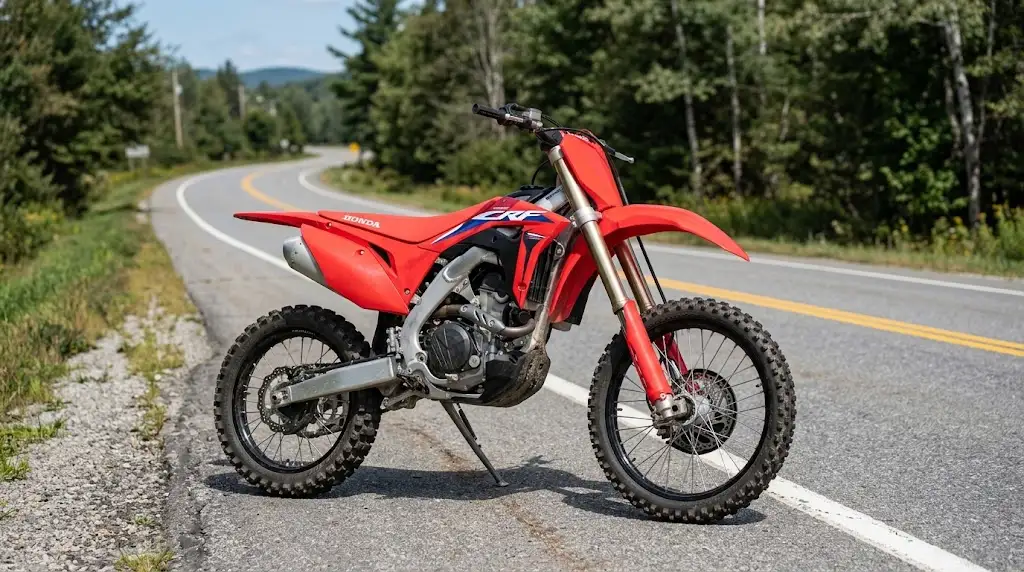
The standard CRF450R is a motocross motorcycle. Honda positions the model within its motocross lineup rather than its street-bike lineup, and its design prioritizes closed-course performance, responsive handling, powerful acceleration, and competition-focused suspension.
That means buyers should not assume that a standard CRF450R can simply be registered for normal road use after installing street equipment.
Whether a particular motorcycle can be titled, registered, inspected, and operated on public roads depends on applicable federal requirements and the laws of the state where it will be registered. NHTSA has explained that federal law addresses vehicle safety standards, while licensing and operation are largely matters handled by individual states.
Why the CRF450R Is Different From a Factory Street Motorcycle
The CRF450R is engineered around motocross conditions. Its specifications illustrate that purpose: the current model uses a 450cc liquid-cooled single-cylinder four-stroke engine, a close-ratio five-speed transmission, long-travel Showa suspension, motocross tires, and a high ground-clearance chassis.
These characteristics are valuable on a closed course, where acceleration, jumps, corners, braking zones, and changing terrain are central to the riding experience. They do not by themselves establish compliance with public-road requirements.
A factory street motorcycle is designed and certified with road use in mind. A competition motocross motorcycle starts from a different regulatory and engineering foundation.
What Does a Street-Legal Motorcycle Generally Need?
Road-use requirements vary by jurisdiction, but street motorcycles generally need equipment and documentation appropriate for public-road operation.
- Approved lighting equipment
- Front and rear turn signals where required
- Rearview mirrors
- A compliant horn
- Required braking equipment
- Road-appropriate tires
- Required reflectors or visibility equipment
- A compliant exhaust and emissions configuration where applicable
- A valid VIN and required vehicle documentation
- Title and registration
- Required motorcycle insurance
- A motorcycle license or endorsement
The exact list should always be checked with the relevant state motor-vehicle agency. NHTSA identifies several federal motorcycle safety standards covering areas such as lighting, mirrors, brakes, tires, controls, and other equipment, but meeting an equipment checklist does not automatically guarantee that a particular off-road motorcycle can be registered for street use.
Can You Convert a CRF450R for Street Use?
This is where the CRF450R street-legal discussion becomes more complicated.
Some riders explore conversions involving lighting systems, mirrors, signals, road tires, wiring, horns, speedometers, and other equipment. However, the ability to install these components is different from having a motorcycle that is legally eligible for road registration.
Before spending money on a conversion, check your state’s requirements for an off-road or competition motorcycle. Determine whether the state allows the specific type of vehicle to be titled and registered and whether it requires inspection, documentation, a special certification, or other evidence of compliance.
Do not rely solely on an aftermarket conversion kit’s marketing language. A kit can supply physical equipment without changing the underlying federal or state classification of the motorcycle.
Federal Safety Standards Matter
NHTSA explains that motorcycles manufactured for on-road use are subject to applicable Federal Motor Vehicle Safety Standards. NHTSA also distinguishes competition cycles and off-road machines from motorcycles designed and manufactured primarily for public-road use.
This distinction is important because a motorcycle’s original certification status can matter even if an owner later adds equipment.
For buyers considering a used CRF450R or another competition motorcycle for conversion, inspect the vehicle documentation before making a purchase. Ask specifically about its original classification, VIN documentation, title history, and eligibility for registration in your state.
Emissions and Exhaust Considerations
Emissions are another area that should not be overlooked.
The EPA regulates emissions from motorcycles and distinguishes between highway motorcycles and recreational vehicles such as off-highway motorcycles. Modifying an engine or emissions-related system can create compliance issues when the modification affects emissions controls.
That means an aftermarket exhaust or engine modification should not be treated as automatically acceptable simply because it improves performance. If the motorcycle is being prepared for legal road use, investigate the emissions requirements that apply to the vehicle and jurisdiction before making modifications.
CRF450R Performance: What Makes It So Capable?
The reason riders are interested in a CRF450R street-legal setup is easy to understand. The motorcycle has a strong competition-oriented specification sheet.
The current CRF450R uses a 450cc liquid-cooled single-cylinder four-stroke engine and close-ratio five-speed transmission. Honda also equips the model with Showa suspension, a 260mm front disc brake, a 240mm rear disc brake, fuel injection, hydraulic clutch operation, and Honda Selectable Torque Control.
For motocross use, these features are designed around responsive power delivery and precise control. Riders coming from other forms of sports and physical activity should also remember that operating a high-performance motorcycle requires specific skills that are different from general fitness or recreational exercise.
CRF450R Handling and Chassis Characteristics
The CRF450R uses a lightweight aluminum chassis and long-travel suspension intended for motocross conditions. Its high ground clearance and motocross-oriented tires are useful characteristics on a dirt track but may not provide the same road behavior as a purpose-built street motorcycle.
Changing tires, gearing, suspension settings, or other components can alter how the motorcycle behaves. Those changes should be approached carefully because improving one characteristic can affect braking, stability, acceleration, or control somewhere else.
For anyone interested in vehicle performance generally, the site’s coverage of professional vehicle care, automotive service, and routine vehicle maintenance provides useful background on why mechanical condition matters.
Maintenance Before Any Road Riding
Whether a motorcycle is used on a track or is legally registered for road use, maintenance remains essential.
Before riding, inspect tire condition and pressure, brake operation, fluid levels, chain condition, controls, fasteners, and visible signs of leaks or damage. NHTSA specifically recommends checking tire condition, brakes, lights, fluid levels, and other basic items before motorcycle rides.
Regular servicing is particularly important for a high-performance competition motorcycle. Oil and filter maintenance, chain adjustment, air-filter service, valve inspection, and suspension maintenance can all contribute to reliable operation.
Owners can also compare the maintenance philosophy used for motorcycles with broader tire and vehicle care practices when building a preventive-maintenance routine.
Street Tires vs. Motocross Tires
One of the most obvious differences between motocross and street riding is the tire environment.
The CRF450R is supplied with motocross-oriented tires designed for dirt-track conditions. Public-road surfaces are different. Asphalt, painted road markings, standing water, temperature changes, and highway speeds place different demands on tires.
If a conversion is legally permitted in your jurisdiction, the replacement tire must be appropriate for the motorcycle and intended operating conditions. Tire selection should also remain within the specifications and load requirements appropriate for the motorcycle.
Insurance, Registration, and Documentation
Legal road use requires more than mechanical preparation.
Depending on your jurisdiction, you may need a title, registration, insurance, inspection, license plate, and motorcycle endorsement. Documentation can become especially important when a vehicle was originally sold as an off-road competition motorcycle.
Before purchasing a CRF450R specifically for conversion, contact your state’s motor-vehicle authority and ask about the exact vehicle classification. Also ask whether a competition motorcycle can be titled and registered for public-road use and what documentation is required.
Insurance requirements should be confirmed separately with an insurer that covers motorcycles. RenewWire’s existing coverage of insurance considerations and vehicle-related protection can provide broader context, although motorcycle-specific requirements should always be confirmed with the insurer.
CRF450R vs. a Factory-Built Street Motorcycle
If your primary objective is commuting or regular public-road riding, compare the CRF450R with a motorcycle that was originally manufactured and certified for road use.
A purpose-built street motorcycle generally starts with road equipment, road-oriented geometry, road tires, lighting, mirrors, controls, and certification designed around public-road operation.
The CRF450R, by contrast, starts as a motocross machine. Its attraction is its competition-focused performance and handling characteristics. That makes it an interesting platform for experienced riders, but it also makes the legal and practical questions surrounding conversion more significant.
What About Other Street-Legal Off-Road Vehicles?
If your goal is to combine off-road capability with legal road travel, consider researching vehicles that were specifically engineered and sold for dual-purpose use.
For example, RenewWire also covers the ROXOR street-legal question, which illustrates the broader distinction between an off-road-oriented vehicle and one configured for road use.
The same principle applies to other recreational machines: always establish the vehicle’s legal classification before assuming that aftermarket equipment automatically makes it road legal.
Is a CRF450R a Good Choice for Public Roads?
That depends heavily on what you want from the motorcycle.
For closed-course motocross, the CRF450R is purpose-built around performance. For regular commuting, long-distance road travel, or everyday highway use, a motorcycle designed and certified for those environments may be more straightforward from a registration, equipment, maintenance, and usability perspective.
If you are considering a CRF450R conversion, the first question should therefore be legal eligibility rather than performance upgrades.
Checklist Before Attempting a CRF450R Street-Legal Conversion
- Confirm that your state permits the motorcycle’s registration for public-road use.
- Check the motorcycle’s VIN and original documentation.
- Determine whether inspection or certification is required.
- Review required lighting, mirrors, signals, horn, brakes, and reflectors.
- Confirm applicable emissions requirements.
- Use road-appropriate tires if legally permitted and technically suitable.
- Verify insurance availability before completing the project.
- Confirm title, registration, and license-plate requirements.
- Obtain the correct motorcycle license or endorsement.
- Have the finished motorcycle inspected by a qualified professional where appropriate.
Final Thoughts on the CRF450R Street Legal Question
The Honda CRF450R delivers the kind of motocross-focused engineering that makes it attractive to performance enthusiasts, but calling a standard CRF450R “street legal” without qualification can be misleading.
The key issue is not simply whether lights, mirrors, signals, or other street equipment can be installed. The bigger question is whether the specific motorcycle is legally eligible for public-road registration and operation in the jurisdiction where you intend to ride.
Before spending money on a conversion, verify the rules with the relevant state motor-vehicle authority, review the motorcycle’s original documentation, and consider emissions and federal safety requirements. If the objective is dependable everyday road transportation, comparing the CRF450R with a factory-built street or dual-purpose motorcycle may also make sense.
The CRF450R remains an impressive competition motorcycle. Understanding its original purpose and the legal requirements surrounding public-road use is the best starting point for making an informed decision about how and where to ride it.