




That distinction matters because road legality is not determined only by whether a vehicle has headlights, tires, mirrors, or other road-going equipment. Registration, title classification, safety requirements, emissions requirements, local laws, and vehicle classification can all affect whether a particular ROXOR may legally operate on public roads.
What Is the Mahindra ROXOR?
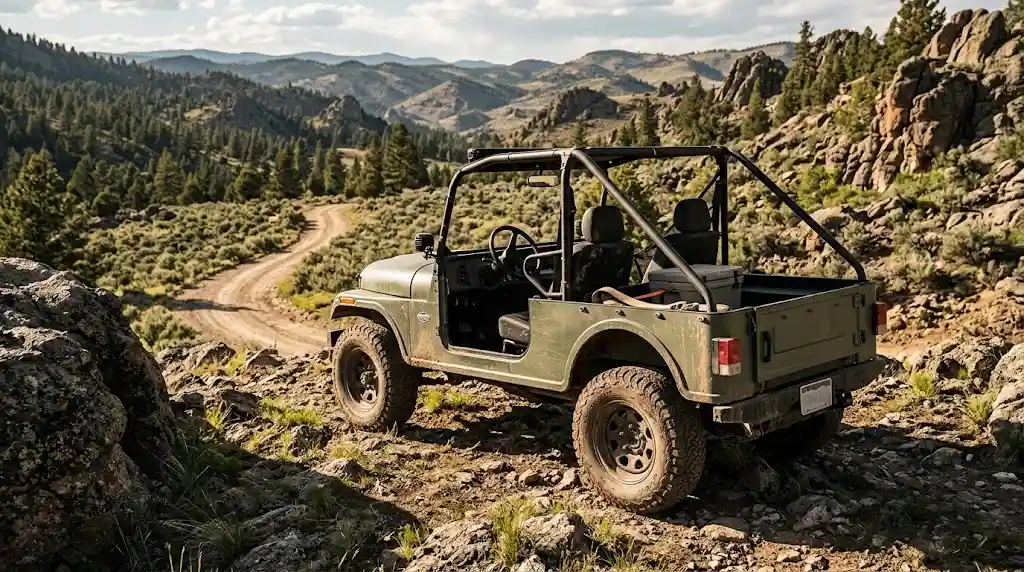
The Mahindra ROXOR is a rugged side-by-side utility vehicle developed for off-road use. Its appeal comes from a combination of a steel body, boxed steel frame, four-wheel-drive capability, manual transmission, substantial towing ability, and a diesel powertrain.
Current ROXOR HD models use a 2.7-liter turbo-diesel engine producing 55 horsepower and 144 lb-ft of torque. Mahindra lists a towing capacity of up to 3,500 pounds, making the vehicle particularly interesting to users who want an off-road machine that can also perform practical work.
For outdoor enthusiasts, the ROXOR occupies an unusual position between traditional utility vehicles and recreational side-by-sides. It is designed around durability and utility rather than being a conventional road-going SUV.
If you are comparing it with other performance-oriented machines, our guide to CRF450R street-legal considerations provides another useful perspective on the difference between off-road performance and public-road requirements.
Is the ROXOR Street Legal?
Not in its standard factory configuration.
Mahindra’s current ROXOR website describes the vehicle as an off-road vehicle only and specifically states that it is not legal for use on public streets or highways. The 2026 ROXOR operator’s guide also emphasizes that the vehicle is not equipped or legal to operate on public streets, roads, or highways.
This is an important distinction for anyone searching for a “Roxor street legal” model. A vehicle can be capable of driving on pavement without being legally approved for normal public-road use.
Some owners may investigate modifications, registration procedures, or state-specific conversion requirements. However, those possibilities should not be interpreted as a universal factory street-legal status. Requirements can differ substantially between jurisdictions, and owners are responsible for confirming the rules that apply where the vehicle will actually be operated.
Why Does the Street-Legal Question Matter?
Buying an off-road vehicle with the expectation that it can automatically be driven to work, to a shopping center, or between trail systems can create significant problems.
Public-road operation can involve several separate legal and practical requirements, including:
- Vehicle classification
- Title and registration requirements
- Required lighting equipment
- Turn signals and brake lights
- Mirrors and visibility equipment
- Horn requirements
- Windshield requirements
- Safety equipment
- Insurance requirements
- State and local operating restrictions
- Road-speed and highway restrictions
Because these requirements can vary, buyers should verify them with the relevant motor-vehicle authority before assuming that a modified or specially registered ROXOR can be used legally on public roads.
ROXOR Is Built for Off-Road Adventure
The ROXOR makes much more sense when viewed through its intended purpose: off-road transportation and utility work.
Its boxed-steel frame and steel body are designed around durability. The current ROXOR HD also uses a five-speed manual transmission and a two-speed transfer case, with selectable two-wheel-drive and four-wheel-drive operation.
That combination gives the ROXOR a mechanical character that appeals to drivers who want direct control and a vehicle designed for demanding terrain.
Rather than treating public-road capability as the main attraction, buyers should evaluate the ROXOR according to where they actually intend to use it. Farms, private property, trails, work sites, hunting areas, and other permitted off-road environments may better match its design philosophy.
ROXOR Performance and Utility
Performance is one of the reasons the ROXOR attracts attention. Current specifications include a 2.7-liter turbo-diesel engine, 55 horsepower, 144 lb-ft of torque, and a listed towing capacity of 3,500 pounds.
The vehicle also uses a boxed-steel chassis, heavy-duty transmission, hydraulic power brakes, roll-over protection, and three-point seat belts.
Its maximum listed speed is 55 mph, but maximum speed should never be confused with authorization to use a vehicle on public highways. A vehicle’s mechanical ability to reach a particular speed does not make it a road-legal automobile.
ROXOR HD vs. All-Weather Configuration
Current ROXOR offerings include the HD base configuration and an HD All-Weather model. Both are built around the same basic utility-oriented platform, but the All-Weather version adds equipment designed to improve comfort and protection from the elements.
The All-Weather configuration includes features such as a composite cab, climate control, windshield, wipers, and additional convenience equipment. These additions may make the vehicle more comfortable during extended use, but they should not automatically be interpreted as converting the ROXOR into a conventional street-legal vehicle.
This distinction is particularly important for buyers who see road-oriented equipment and assume that all legal requirements have therefore been satisfied.
Can You Modify a ROXOR for Road Use?
This is where the subject becomes jurisdiction-specific.
Some owners explore adding equipment such as turn signals, mirrors, horns, windshields, road-rated tires, lighting, or other components. Depending on the jurisdiction, additional requirements may apply before an off-road vehicle can qualify for road operation.
However, simply installing road-oriented equipment does not guarantee legal registration. A state’s definition of an off-highway vehicle, UTV, side-by-side, assembled vehicle, or other vehicle class can determine what conversion or registration pathway is available.
Before spending money on modifications, check the requirements of the exact state and locality where you intend to operate the vehicle. If the jurisdiction does not permit the vehicle to be registered for normal public-road use, adding equipment will not necessarily change that classification.
Street-Legal UTV Rules Can Vary by State
One of the biggest reasons online discussions about ROXOR legality can become confusing is that “street legal” does not have one universal definition across the United States.
One state may allow certain side-by-sides on selected public roads if specific equipment and registration requirements are satisfied. Another jurisdiction may impose much stricter restrictions or prohibit normal road use altogether.
There can also be differences between:
- Public streets
- County roads
- Designated off-road routes
- Private property
- Low-speed roads
- Highways and interstate routes
Therefore, a statement that a particular ROXOR is “street legal” should always be accompanied by the specific jurisdiction, registration status, and applicable conditions.
What to Check Before Buying a ROXOR
If you are considering a ROXOR, start with your intended use rather than the appearance of the vehicle.
1. Determine Where You Will Drive
Make a realistic list of the locations where you expect to use the vehicle. If most of your driving will occur on trails, farms, private land, or permitted recreational areas, the ROXOR’s off-road design may fit your needs well.
2. Check Local Registration Rules
Contact the relevant state motor-vehicle or transportation authority before purchasing if public-road use is important to you. Ask specifically about the vehicle’s classification and whether a ROXOR can be titled and registered for the roads you intend to use.
3. Understand Insurance Requirements
Insurance needs can vary depending on how and where the vehicle is operated. Buyers should confirm what coverage is appropriate for an off-road utility vehicle and whether additional coverage is required for any permitted road use.
For broader vehicle-protection considerations, RenewWire also covers topics such as vehicle gap insurance and insurance protection options.
4. Consider Maintenance and Service
A rugged off-road vehicle can experience demanding operating conditions. Tires, brakes, suspension components, fluids, drivetrain components, and other systems deserve regular inspection.
Our related vehicle-care resources, including tire and auto service guidance, professional vehicle care, car-care solutions, and routine vehicle service can provide useful maintenance context.
ROXOR for Work and Utility Applications
The ROXOR’s strongest argument is arguably its utility capability.
With substantial towing capacity, a durable chassis, four-wheel-drive capability, and a practical cargo area, it can be useful for people who need an off-road machine for more than recreational driving.
For agricultural users, property owners, outdoor workers, and recreational land managers, a utility side-by-side can help transport equipment and supplies over terrain where a conventional passenger car would be inappropriate.
That utility-oriented philosophy also makes the ROXOR different from a lightweight recreational machine. Buyers should consider payload, towing needs, terrain, storage, service access, and operating conditions rather than focusing only on styling or top speed.
ROXOR and Outdoor Adventure
For recreational users, the ROXOR can provide a distinctive way to explore permitted off-road environments.
Its rugged construction, four-wheel-drive system, ground clearance, and utility-focused layout make it well suited to people who prefer slower, controlled exploration over conventional highway travel.
If you are planning a broader outdoor setup, you can also explore our article about the TrailManor 2720 Sport adventure trailer for another perspective on combining transportation and outdoor recreation.
Outdoor gear and recreation can also be part of the overall experience. Our guide to Timberline Sports and outdoor adventure gear provides a related resource for enthusiasts planning active trips.
Safety Should Come Before Adventure
Responsible ROXOR operation begins with understanding that the vehicle behaves differently from an ordinary passenger vehicle.
Operators should wear seat belts, use appropriate protective equipment, respect the vehicle’s load limits, reduce speed for difficult terrain, and avoid aggressive maneuvers that can increase rollover risk.
The 2026 operator’s guide specifically warns that abrupt steering, hard acceleration, sudden braking, steep terrain, obstacles, and inappropriate speeds can contribute to loss of control or rollover.
Passengers should also use the vehicle’s available restraint systems and follow the manufacturer’s operating guidance. Safe off-road driving requires paying attention to terrain, visibility, weather, surface conditions, and the experience level of everyone operating or riding in the vehicle.
ROXOR vs. a Conventional 4×4
A conventional 4×4 SUV and a ROXOR may look similar in photographs, but they serve different purposes.
A conventional SUV is engineered and certified as a road vehicle, with systems and equipment designed around public-road transportation. The ROXOR is designed as an off-road side-by-side with a strong emphasis on utility and rugged terrain.
If your primary requirement is commuting on public roads, a properly road-certified SUV or truck may be the more straightforward choice. If your priority is off-road utility and recreational terrain access, the ROXOR may be much more aligned with that use case.
For readers considering the cost side of vehicle ownership, RenewWire also covers vehicle financing considerations.
How to Evaluate a Used ROXOR
If you are shopping for a used ROXOR, do not evaluate it only by mileage or appearance.
Inspect the frame, suspension, drivetrain, brakes, tires, steering components, cargo area, electrical systems, and protective structures. Ask about previous use, especially if the vehicle was operated heavily on rocky terrain, steep trails, farms, or work sites.
Maintenance records can be especially valuable because they provide evidence of how the vehicle was cared for.
Also confirm the title and registration history. If a seller describes a particular ROXOR as “street legal,” verify exactly what that means, where it is registered, and whether that status would remain valid if the vehicle were transferred to another state.
Common ROXOR Street-Legal Mistakes to Avoid
Several misunderstandings can create problems for potential buyers.
- Assuming road equipment equals road legality: Adding mirrors or lights does not automatically establish legal registration.
- Confusing pavement capability with legal approval: A ROXOR can physically operate on paved surfaces, but that does not make it a public-road vehicle.
- Relying on another state’s rules: A registration or conversion pathway in one jurisdiction may not apply elsewhere.
- Ignoring insurance requirements: Confirm coverage before operating the vehicle where insurance is required.
- Assuming every used ROXOR has the same legal status: Title, registration, modifications, and location can affect the situation.
Is a ROXOR Right for You?
The answer depends heavily on your intended use.
If you want a rugged diesel side-by-side for off-road recreation, property work, hauling, towing, and demanding terrain, the ROXOR offers a compelling combination of mechanical simplicity and utility.
If your main goal is to own a vehicle that can legally travel public streets every day, you should approach the purchase differently. Do not assume that the ROXOR’s automotive styling, road-going equipment, or speed capability makes it equivalent to a street-certified SUV.
Instead, investigate your local laws first and determine whether the vehicle’s classification and registration options actually satisfy your intended use.
Final Thoughts on Roxor Street Legal Status
The Roxor street legal debate is best understood by separating three different ideas: what the vehicle can physically do, what equipment it has, and what the law permits.
Mahindra’s current ROXOR is designed and sold as an off-road vehicle, and its standard configuration is not legal for ordinary public-street or highway operation. State and local rules may create different possibilities for certain modified or specially registered vehicles, but those possibilities must be verified for the exact jurisdiction and vehicle.
For buyers, the safest approach is straightforward: define your intended use, verify the classification, check local registration requirements, understand insurance obligations, and follow the manufacturer’s safety guidance before taking the wheel.
That approach lets you enjoy what the ROXOR is actually designed to deliver—rugged off-road capability and practical utility—without confusing adventure with unrestricted public-road access.
Frequently Asked Questions
Is the Mahindra ROXOR street legal?
The current ROXOR is sold as an off-road vehicle and is not legal for normal public-street or highway use in its standard configuration. Local laws may provide different requirements or registration options, so buyers should verify the rules applicable to their jurisdiction.
Can you make a ROXOR street legal?
In some jurisdictions, owners may investigate conversion and registration options, but requirements vary. Adding road equipment alone does not guarantee legal status. Always verify classification, equipment, title, registration, and insurance requirements with the relevant authorities.
What engine does the current ROXOR HD use?
Current ROXOR HD models use a 2.7-liter turbo-diesel engine rated at 55 horsepower and 144 lb-ft of torque.
How much can a ROXOR tow?
Mahindra currently lists up to 3,500 pounds of towing capacity for the ROXOR HD models.
Is ROXOR a Jeep?
No. ROXOR is a Mahindra side-by-side utility vehicle. Its rugged styling may remind some people of traditional 4×4 vehicles, but it is designed and classified for off-road use rather than as a conventional road-going SUV.
Can a ROXOR be driven on pavement?
The vehicle can physically operate on paved surfaces, but that should not be confused with public-road legality. The manufacturer’s guidance states that the ROXOR is designed for off-road use and is not legal for normal public streets, roads, or highways in its standard configuration.
What should I check before buying a used ROXOR?
Check the vehicle’s title and registration history, maintenance records, frame and drivetrain condition, brakes, suspension, tires, steering, safety equipment, and any modifications. If the seller claims the vehicle is street legal, independently verify that claim for the jurisdiction where you intend to use it.