




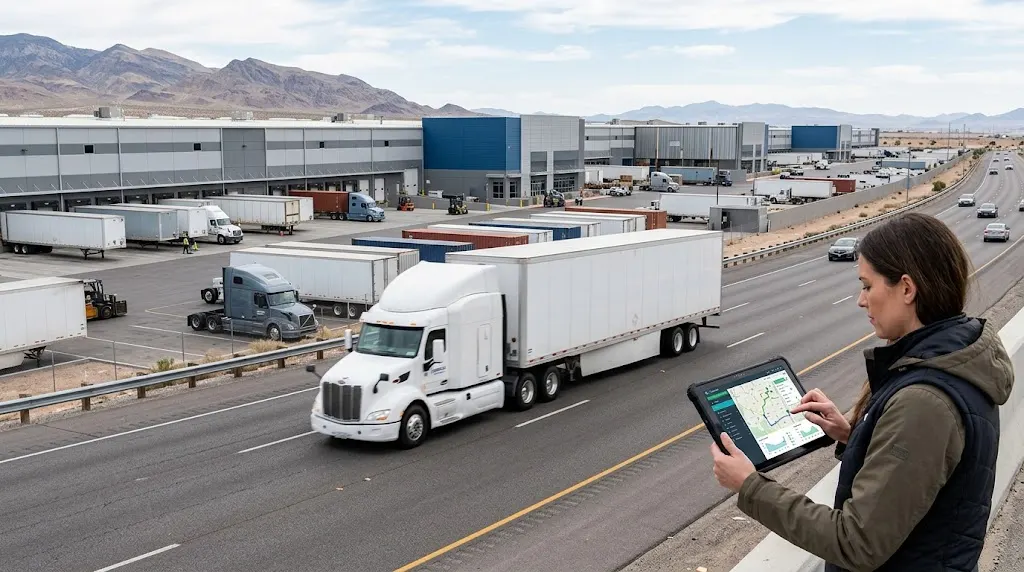
This guide explores how Hyperlux approaches freight management, the services it provides, the role of shipment visibility, and the factors businesses should consider when evaluating a logistics partner.
What Is Hyperlux Logistics?
Hyperlux Logistics is a transportation and third-party logistics company based in Loveland, Ohio. Its business model focuses on connecting shippers with carrier capacity while providing communication, shipment coordination, and technology-supported visibility throughout the transportation process.
For businesses, the value of a 3PL is often found in simplifying transportation management. Instead of coordinating every carrier relationship, shipment update, and capacity decision internally, a logistics provider can help organize those activities through an established network and operational team.
Hyperlux describes its approach as people-first, combining logistics expertise with technology and carrier relationships. Its official Hyperlux Logistics website presents its services around freight efficiency, real-time tracking, scalable shipping solutions, and support for both shippers and carriers.
How Hyperlux Fits Into the Modern Supply Chain
Supply chains have become increasingly dependent on reliable transportation coordination. A manufacturing company may need raw materials delivered on schedule, while a distributor may need finished products moved between facilities or customers. Ecommerce businesses can face another layer of complexity because transportation performance directly affects fulfillment and customer expectations.
That makes logistics management an operational function rather than simply a transportation expense. Businesses must consider carrier availability, shipment timing, freight type, communication, tracking, and cost when planning transportation.
Hyperlux’s model addresses these requirements through freight brokerage and logistics services. Its positioning is particularly relevant to businesses that want to combine external carrier capacity with a dedicated logistics team.
Companies exploring broader business growth strategies may also find related insights in consumer products and services growth strategies, particularly where transportation needs change as sales volumes increase.
Freight Services Offered by Hyperlux
Hyperlux provides several transportation options designed around different shipment sizes, urgency levels, and capacity requirements. Understanding the differences between these services can help businesses determine which type of freight solution fits a particular load.
“`
Full Truckload Freight
Full truckload, commonly abbreviated as FTL, is generally appropriate when a shipment requires dedicated truck capacity. Instead of sharing space with multiple unrelated shipments, the freight occupies the truck for the intended movement.
FTL can be useful for larger shipments, time-sensitive transportation requirements, or freight where dedicated capacity makes operational sense. Hyperlux highlights FTL as one of its core shipping solutions for businesses that need consistency and capacity.
Expedited Partial Freight
Expedited partial freight provides an option between conventional LTL transportation and a fully dedicated truckload. The objective is to balance urgency, available capacity, transit requirements, and transportation cost.
This type of service can be useful when freight needs to move faster than a conventional option but does not necessarily require an entire truck.
Less-Than-Truckload Shipping
Less-than-truckload, or LTL, is designed for smaller shipments that do not require a full truck. Freight can be consolidated through carrier networks, helping businesses avoid paying for dedicated truck capacity when the shipment size does not justify it.
The right choice depends on factors such as shipment dimensions, weight, destination, timing, handling requirements, and cost.
Businesses interested in related transportation technology can also explore APX logistics tracking and shipment visibility for another perspective on how tracking technology supports freight operations.
“`
Real-Time Tracking and Shipment Visibility
Shipment visibility is one of the most important technology-related considerations in modern logistics. Without reliable updates, a shipper may have difficulty knowing whether a load has departed, where it is currently located, or whether a delivery issue needs attention.
Hyperlux emphasizes real-time tracking as part of its logistics approach. Visibility can help shippers and logistics teams communicate more effectively and respond to changes during transportation.
Tracking is particularly valuable when multiple parties are involved. A shipper, carrier, logistics coordinator, warehouse team, and receiving location may all need access to timely shipment information.
This technology-driven approach also connects with broader discussions around technology and future-ready business growth, where digital systems increasingly support operational decision-making.
Why Carrier Relationships Matter
A logistics provider cannot deliver transportation solutions without dependable carrier relationships. Carrier availability, communication, equipment, geographic coverage, and service performance can all influence whether a shipment moves according to plan.
Hyperlux maintains a separate carrier-focused operation designed to provide freight opportunities, communication, and payment support. Its carrier program describes its relationship with carriers as a partnership rather than simply a transactional load arrangement.
From a shipper’s perspective, a broad and reliable carrier network can provide greater flexibility when capacity changes. It can also help a logistics provider identify transportation options for different lanes, shipment types, and business requirements.
Related logistics coverage on RenewWire includes Raymont Logistics and supply chain efficiency, which provides another internal resource for readers researching logistics operations.
Supporting Small and Mid-Sized Businesses
Large enterprises often have dedicated transportation departments, procurement teams, carrier contracts, and sophisticated logistics software. Smaller businesses may not have the same internal resources.
A 3PL can therefore provide operational support without requiring a growing company to build every transportation capability internally. Hyperlux specifically describes solutions for small and mid-sized businesses, including flexible shipping support, quoting, booking, carrier access, and logistics assistance.
As a company grows, transportation requirements can change quickly. A business may move from occasional shipments to recurring freight lanes, seasonal demand, or multiple distribution locations. Scalable logistics support can become increasingly important during that transition.
Businesses researching operational expansion can also review how digital business strategies influence growth and consider how transportation capacity needs to evolve alongside customer acquisition.
Enterprise-Level Logistics and Scalability
Enterprise shippers often face a different set of logistics challenges. They may manage large shipment volumes, multiple carriers, numerous lanes, complex reporting requirements, and several internal stakeholders.
Hyperlux offers an enterprise-oriented approach that includes nationwide carrier access, reporting and analytics, dedicated account management, and systems integration. Its enterprise shipping solutions also describe integrations with ERP, transportation management systems, and other internal platforms.
Systems integration can reduce the need to manually transfer information between platforms. When shipment information, reporting, and operational workflows are connected, logistics teams can spend more time managing exceptions and performance rather than repeatedly entering data.
Technology is also increasingly connected with business transformation, as discussed in advanced digital transformation strategies.
The Role of Technology in Freight Management
Technology does not replace logistics expertise, but it can make transportation operations easier to monitor and manage. Tracking systems, reporting tools, integrations, automated workflows, and data analysis can provide a more complete view of freight activity.
For a shipper, useful technology should answer practical questions. Where is the shipment? What is its current status? Are there delays? Which transportation lanes are performing well? Where are costs increasing? Which operational issues happen repeatedly?
These questions demonstrate why logistics technology is most valuable when it supports decisions rather than simply producing more data.
Readers interested in technology-driven business services can also explore modern business technology solutions and technology-focused business services for broader context.
Hyperlux Logistics and Supply Chain Efficiency
Supply chain efficiency is ultimately about coordinating resources, information, and transportation in a way that supports business objectives. A shipment that arrives at the wrong time can create problems even if the transportation cost was low. Conversely, paying for unnecessary speed or capacity can reduce profitability.
Effective logistics planning therefore requires a balance between service levels and transportation costs. Freight mode, shipment size, urgency, carrier availability, destination, and operational requirements all influence the decision.
Hyperlux positions its services around this balance by offering multiple freight options rather than treating every shipment identically.
Another related RenewWire resource is LST Logistics and modern supply chain efficiency, which can provide additional internal reading for businesses exploring transportation strategies.
Logistics for Ecommerce and Growing Businesses
Ecommerce growth can create significant transportation demands. As order volumes increase, businesses may need more structured fulfillment, inventory movement, carrier coordination, and delivery planning.
Transportation therefore needs to scale alongside digital commerce. A business that invests heavily in customer acquisition but cannot reliably move products can encounter operational bottlenecks.
Readers exploring this relationship can review digital marketing’s impact on ecommerce and advanced ecommerce strategies alongside logistics planning.
The goal is not to treat logistics and ecommerce as separate functions. Customer demand, inventory availability, fulfillment, transportation, and delivery performance are connected parts of the same commercial process.
How Businesses Can Evaluate a 3PL
Choosing a logistics provider should involve more than comparing a quoted transportation rate. Businesses should evaluate the provider’s capabilities against their actual operational requirements.
“`
1. Review Freight Capabilities
Determine whether the provider handles the shipment types, volumes, equipment requirements, and geographic lanes your business needs.
2. Evaluate Visibility
Ask how shipment tracking works and how quickly your team receives updates when transportation conditions change.
3. Consider Communication
Clear communication matters when shipments encounter delays, appointment issues, capacity shortages, or other exceptions.
4. Examine Scalability
A logistics partner should be able to support changes in shipment volume without forcing the business to rebuild its transportation process every time demand changes.
5. Look at Technology Integration
Businesses using ERP, TMS, inventory, or reporting platforms should determine whether the logistics provider can work effectively with existing systems.
6. Compare Total Value
The lowest transportation quote is not necessarily the lowest overall logistics cost. Delays, poor communication, manual work, missed appointments, and limited visibility can create additional operational expenses.
For a broader business-services perspective, business services and operational excellence can also be considered when evaluating how external partners contribute to company growth.
“`
What Makes a Modern Logistics Partner Useful?
A modern logistics partner generally needs to combine several capabilities: transportation expertise, carrier relationships, technology, communication, and scalable processes.
Hyperlux’s current service model brings these elements together through freight brokerage, shipper support, carrier relationships, shipment visibility, and technology-enabled logistics management.
Its approach is particularly relevant for businesses that want external transportation expertise while retaining greater visibility into their freight operations.
For companies evaluating logistics providers, the key question is ultimately whether the provider’s network, services, technology, and support model align with the company’s actual shipping requirements.
Hyperlux Logistics: A Technology-Enabled Freight Approach
Hyperlux Logistics represents a modern third-party logistics model in which freight coordination is supported by carrier relationships, shipment visibility, scalable transportation services, and technology.
Its service range includes full truckload, expedited partial, and LTL transportation, while its shipper-focused model is designed to support both growing businesses and larger operations. The company’s emphasis on communication and visibility reflects the increasing importance of real-time information in supply chain management.
For businesses researching logistics providers, Hyperlux offers a useful example of how freight brokerage is evolving beyond simple carrier matching toward a broader combination of transportation coordination, technology, analytics, and operational support.
Readers interested in another logistics-focused perspective can also explore Coppersmith Global Logistics and supply chain management.
Final Thoughts
Efficient transportation is a critical component of a dependable supply chain. Businesses need more than trucks and routes; they need visibility, communication, capacity, technology, and processes that can adapt as shipping requirements change.
Hyperlux Logistics operates within this evolving environment by connecting shippers and carriers while offering multiple freight options and technology-supported visibility. Its approach illustrates why modern 3PL providers increasingly function as strategic logistics partners rather than simply intermediaries.
For any business considering a logistics provider, the most useful evaluation starts with its own requirements: freight type, shipment frequency, lanes, service expectations, technology needs, reporting requirements, and growth plans. Those factors provide the foundation for determining whether a particular logistics model is appropriate.