




What Is Axel Technology SRL?
Axel Technology SRL, operating under the AxelTech brand, is headquartered in Anzola Emilia near Bologna, Italy. Its official website identifies the company as a provider of radio and TV broadcasting technology and lists additional locations in Bergamo and Pisa.
The company’s portfolio is designed around professional broadcasting rather than general consumer electronics. Its solutions address areas such as radio studio production, TV automation, audio processing, broadcast monitoring, media management, and master-control workflows.
This specialization is important because broadcasters have requirements that differ significantly from ordinary business IT. Broadcast environments need reliable operation, predictable workflows, controlled audio and video quality, monitoring, automation, and systems that can integrate into a wider production environment.
Axel Technology SRL and Modern Broadcast Technology
Broadcasting has changed substantially as organizations have moved from traditional hardware-heavy workflows toward software-defined, networked, and increasingly automated production environments.
AxelTech’s current portfolio reflects that shift. Its website presents solutions across both radio and TV, including digital consoles, audio processors, automation platforms, visual-radio systems, TV production tools, media management, and logging systems.
The broader value of this approach is workflow integration. Instead of viewing a console, automation platform, logger, or production system as an isolated product, broadcasters can evaluate how each component contributes to the complete production chain.
Businesses researching this type of digital transformation can also explore related RenewWire coverage on technology and future-ready business growth.
Axel Technology Radio Solutions
Radio is one of AxelTech’s core areas. Its official radio portfolio includes digital broadcast consoles, audio processors, automation, visual-radio systems, monitoring, and other studio technologies.
Digital Broadcast Consoles
A broadcast console is central to many radio studio workflows. It allows presenters and operators to manage microphones, playback sources, telephone systems, routing, and other audio inputs.
AxelTech’s portfolio includes its Oxygen family of broadcasting consoles. The company currently presents several Oxygen models, including Oxygen 3, Oxygen 3 ST, and Oxygen 3000.
For a broadcaster, the important consideration is not simply the number of controls. Console selection should match the studio’s number of sources, operator requirements, routing architecture, automation workflow, and future expansion plans.
Audio Processing
Audio processing helps broadcasters manage the sound characteristics of their output. Professional processing can be relevant to consistency, loudness management, transmission quality, and the overall listener experience.
AxelTech’s radio portfolio includes audio-processing equipment alongside consoles and monitoring products.
Radio Automation
Automation can help stations schedule and manage programming, music, advertising, news elements, and other recurring content without requiring every operation to be performed manually.
AxelTech offers radio automation as part of its broader broadcast technology portfolio, helping broadcasters build workflows that combine studio operation with software-based control.
Visual Radio
Visual radio extends traditional radio production into video and digital distribution. Instead of producing audio alone, stations can create visual content suitable for websites, social platforms, streaming environments, and other digital channels.
This reflects the changing role of radio stations. A modern broadcaster may need to produce one piece of content for multiple distribution channels rather than treating radio, video, and social media as completely separate operations.
Axel Technology TV Solutions
AxelTech also provides technology for television workflows. Its current TV portfolio covers areas including master control, production control, playout automation, media management, channel branding, logging, and monitoring.
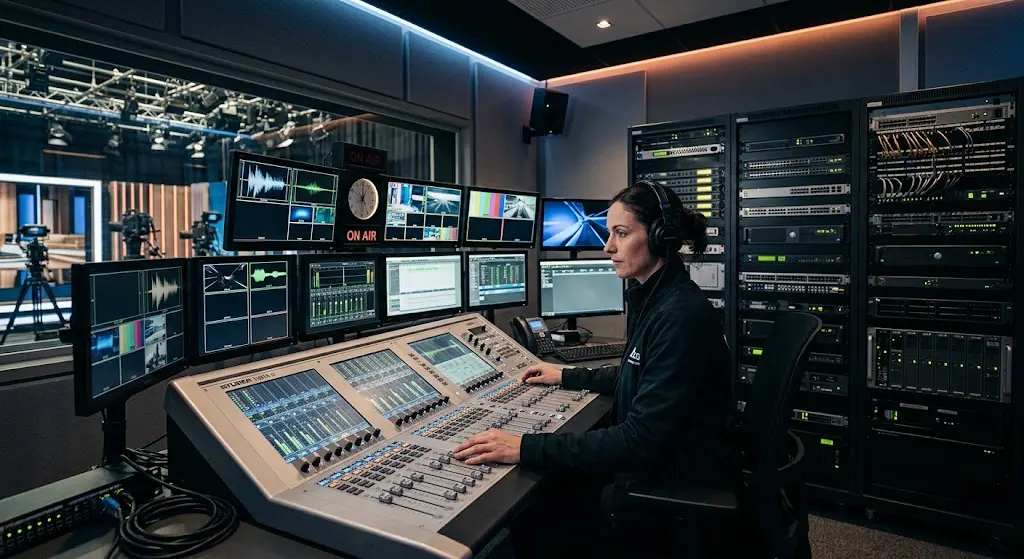
TV Master Control Room
The master control room is responsible for critical broadcast operations and transmission workflows. Reliability and centralized control are particularly important because interruptions can directly affect a channel’s output.
AxelTech presents its TV MCR solution as an all-in-one master-control environment designed for broadcast operations.
Production Control Room
A production control room supports live and recorded television production. It brings together multiple sources and enables operators to manage the program output.
For broadcasters, a well-designed production workflow can reduce unnecessary complexity while making it easier for operators to manage sources and production tasks.
TV Automation and Playout
TV automation can manage scheduled programming and help broadcasters maintain consistent channel output. AxelTech’s portfolio includes XTV Suite and YouPlay, which the company presents as TV automation and production playout solutions.
Automation can be particularly valuable for channels that need to manage large amounts of scheduled content while reducing repetitive manual operations.
Media Asset Management
Media asset management helps organizations organize and control digital audio and video content. As broadcasters accumulate larger libraries, efficient media organization becomes increasingly important.
AxelTech’s TV product portfolio includes XMAM, a media asset management solution designed to support broadcast workflows.
Broadcast Logging and Monitoring
Logging and monitoring are important for broadcasters because organizations need visibility into what has been transmitted or recorded.
AxelTech offers digital media logging solutions for both radio and television. Its A/V Logger portfolio includes DML Audio for radio and DML Video for television.
Broadcast logging can support compliance recording, troubleshooting, content verification, and operational review. The exact requirements vary according to the broadcaster, jurisdiction, and workflow.
Why Broadcast Reliability Matters
Broadcast systems operate under different pressures from ordinary office technology. A workstation failure may inconvenience a business employee, while a failure in a live broadcast workflow can interrupt programming for an entire audience.
For that reason, broadcasters typically evaluate technology based on reliability, redundancy, monitoring, support, ease of operation, integration, and maintainability.
AxelTech states that its solutions are used by radio and TV broadcasters worldwide and emphasizes reliability, efficiency, ease of use, and support.
Organizations researching broader technology reliability can also read technology experience and evaluation insights.
How Axel Technology Supports Broadcast Workflow Efficiency
Efficiency in broadcasting is not simply about making equipment faster. It is about reducing unnecessary manual steps, improving operator visibility, connecting systems effectively, and making recurring tasks easier to manage.
Automation can reduce repetitive operations. Integrated monitoring can improve awareness. Media management can make content easier to locate. Logging can provide a historical record. Professional consoles can centralize audio operations.
When these elements work together, a broadcaster can build a more coherent workflow rather than managing every stage independently.
Axel Technology and System Integration
Integration is increasingly important because broadcasters rarely operate one technology platform in isolation. A radio station or television channel may have storage, automation, production systems, networking, monitoring, content-management tools, transmission equipment, and third-party services.
When evaluating Axel Technology SRL or another broadcast technology provider, organizations should therefore examine compatibility with their existing infrastructure.
Important questions include:
- How does the proposed system connect with existing equipment?
- Which protocols and interfaces are supported?
- Can the system scale as the broadcaster grows?
- How are backups and recovery handled?
- What monitoring capabilities are available?
- How is technical support delivered?
- What training is available for operators?
Axel Technology for Growing Broadcasters
Technology decisions become particularly important when a broadcaster is expanding. A small studio may initially require only basic production tools, but growth can introduce additional channels, locations, content formats, remote production, digital distribution, and more complex scheduling.
A scalable technology strategy helps avoid replacing an entire workflow every time the organization expands.
Businesses considering broader technology-led growth can also explore industrial innovation and technology transformation for another perspective on how technology can support organizational development.
Technical Support and Maintenance
Technology is only useful when organizations can keep it operational. Support and maintenance therefore deserve as much attention as product specifications.
AxelTech maintains a dedicated support function and provides technical assistance for its broadcast technology. Its official support resources are designed around maintenance and technical assistance for customers.
Before choosing a broadcast technology supplier, buyers should understand support availability, response procedures, software updates, hardware maintenance, documentation, and training options.
Axel Tech Academy and Knowledge Development
Technology adoption is more effective when operators understand how to use the systems they are responsible for managing.
AxelTech provides an Axel Tech Academy with educational resources and radio-focused webinars. The company identifies Claudio Astorri as its radio specialist associated with these learning resources.
Training can help reduce the gap between purchasing a sophisticated system and actually obtaining value from it.
Business Benefits of Broadcast Technology
Professional broadcast technology can support businesses in several ways.
Operational Efficiency
Automation and integrated workflows can reduce repetitive manual tasks and make daily operations more consistent.
Content Management
Digital asset management can help teams organize growing libraries of audio and video content.
Reliability
Monitoring, logging, and professional broadcast equipment can provide greater visibility into system operation.
Scalability
Modular technology can make it easier to expand a studio, channel, or digital distribution operation.
Multi-Platform Distribution
Modern broadcasters increasingly publish content through radio, television, websites, streaming services, social platforms, and other digital channels. Technology that supports multiple workflows can therefore provide greater flexibility.
Axel Technology and the Future of Broadcasting
The broadcast industry continues to move toward IP-based workflows, software-defined systems, automation, cloud-connected operations, digital distribution, and increasingly integrated production environments.
These changes do not eliminate the need for professional hardware. Instead, they change how hardware, software, networking, and automation work together.
AxelTech’s current portfolio already reflects this broader direction through its combination of consoles, automation, production systems, media management, monitoring, and turnkey radio and TV solutions.
Readers interested in wider digital transformation can also explore understanding modern technology and how smart technology is changing everyday life.
How to Evaluate Axel Technology SRL for a Business
A business should not select broadcast technology solely because a product appears technically impressive. The solution should fit the organization’s operational requirements.
- Define the workflow: Identify how content is produced, managed, scheduled, monitored, and distributed.
- Identify bottlenecks: Determine which manual or unreliable processes create the most operational friction.
- Check compatibility: Confirm that the proposed solution can integrate with existing infrastructure.
- Evaluate scalability: Consider future channels, users, locations, and content requirements.
- Review support: Understand technical assistance, training, documentation, and maintenance.
- Calculate total cost: Consider licensing, hardware, implementation, support, training, and future upgrades.
- Test usability: Operators should be able to understand the system and perform important tasks efficiently.
Why Total Cost Matters More Than the Initial Price
Technology purchasing decisions can become expensive when organizations focus only on the initial purchase price.
The real cost may include implementation, integration, operator training, maintenance, software updates, support contracts, hardware replacement, and future expansion.
A system that costs more initially may deliver better value if it reduces operational complexity or lasts longer. Conversely, an expensive system may not provide good value if it is unnecessarily complicated for the organization’s actual needs.
Axel Technology and Digital Business Transformation
Broadcast technology is one example of a wider business trend: organizations are using specialized technology to automate repetitive work, manage larger volumes of information, improve reliability, and deliver services across more channels.
The same principles apply outside broadcasting. Companies evaluating technology projects can benefit from defining business goals first and then selecting tools that support those goals.
RenewWire also covers the broader relationship between IT excellence and digital business performance.
Common Mistakes When Choosing Broadcast Technology
Buying for Features Alone
A long feature list does not automatically make a system appropriate. The technology must solve a real operational requirement.
Ignoring Integration
A powerful product can create new problems if it does not work effectively with existing systems.
Underestimating Training
Operators need enough training to use the technology efficiently and safely.
Ignoring Support
Technical support matters when a system becomes business-critical.
Planning Only for Today
A solution should ideally accommodate realistic growth rather than forcing a complete replacement when the organization expands.
Who Can Benefit From Professional Broadcast Technology?
Professional broadcast technology can be relevant to a wide range of organizations, including:
- Commercial radio stations.
- Television broadcasters.
- Digital radio operations.
- Production facilities.
- Media organizations.
- Educational broadcasters.
- Community broadcasters.
- Organizations operating specialized channels.
The appropriate technology depends on the organization’s content, audience, distribution model, staffing, infrastructure, and operational requirements.
Frequently Asked Questions About Axel Technology SRL
What does Axel Technology SRL do?
Axel Technology SRL develops and supplies professional radio and television broadcasting technology. Its portfolio includes radio consoles, audio processors, automation, visual-radio systems, TV automation, production tools, media management, logging, and monitoring.
Where is Axel Technology SRL based?
Axel Technology SRL’s registered headquarters are listed in Anzola Emilia, Bologna, Italy. The company’s official contact page also lists locations in Bergamo and Pisa.
Does Axel Technology provide radio solutions?
Yes. AxelTech has a dedicated radio portfolio covering areas such as broadcast consoles, audio processing, radio automation, visual radio, and monitoring.
Does Axel Technology provide TV solutions?
Yes. Its TV portfolio includes master-control, production-control, automation, playout, media management, channel branding, logging, and monitoring solutions.
What is AxelTech’s Oxygen product family?
Oxygen is a family of professional broadcast mixing consoles offered by AxelTech. The company’s current radio product listings include several Oxygen models.
Does Axel Technology offer technical support?
Yes. AxelTech provides dedicated technical support resources and customer assistance for its products and systems.
Does AxelTech provide training?
AxelTech operates an Axel Tech Academy with educational resources and radio webinars designed to help users develop their knowledge of broadcast technology.Final Thoughts
Axel Technology SRL occupies a specialized position in the professional broadcast technology market. Its portfolio spans radio and television, combining hardware, software, automation, monitoring, media management, production, and support.
The company’s current product range illustrates how modern broadcasting increasingly depends on integrated workflows rather than isolated pieces of equipment. For broadcasters, the most important decision is therefore not simply which product has the most features. It is whether the complete technology environment fits the organization’s workflow, staff, infrastructure, growth plans, and operational goals.
Businesses considering Axel Technology should evaluate technical compatibility, scalability, usability, support, training, integration, and total ownership costs before making a purchasing decision.
For additional RenewWire technology coverage, explore technology evaluation and innovation, industrial technology innovation, and technology-driven business growth.