




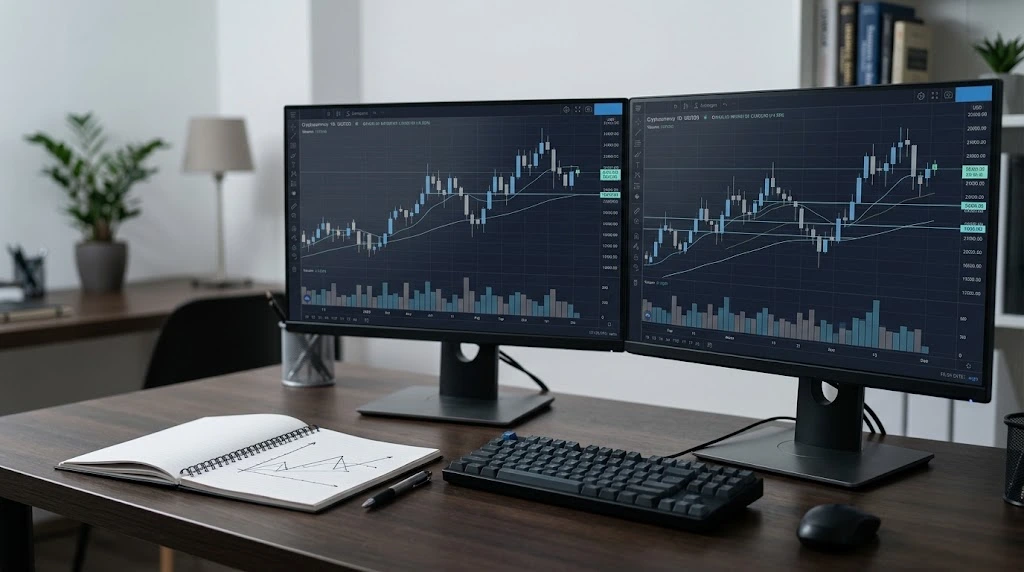
Successful day trading is not about finding a secret formula that guarantees instant returns. It involves developing a repeatable process, identifying suitable market conditions, accounting for trading costs and knowing when not to trade. This guide explains several commonly used cryptocurrency day-trading strategies, how to evaluate them and the precautions beginners should understand before risking capital.
Anyone researching how beginners choose a broker should also understand that platform selection, order execution and fees can influence the practical results of a trading strategy.
What Is Cryptocurrency Day Trading?
Cryptocurrency day trading involves opening and closing trading positions within a relatively short period, often during the same day. Traders may analyze Bitcoin, Ether and other digital assets using price charts, trading volume, market structure and technical indicators.
Unlike a long-term investor who may hold an asset through multiple market cycles, a day trader generally focuses on shorter-term price movements. Some traders look for breakouts from established price ranges, while others attempt to identify temporary pullbacks, momentum changes or reversals near important support and resistance levels.
Crypto markets operate around the clock on many exchanges, so price movements can occur at any hour. Continuous availability does not mean traders need to remain active all day. A defined trading schedule can help reduce fatigue, impulsive decisions and unnecessary transaction costs.
Cryptocurrency trading also involves risks beyond price changes, including exchange failures, cybersecurity incidents, liquidity problems and uncertain legal protections. The CFTC’s advisory on virtual currency trading risks explains why market volatility, platform safeguards and leverage deserve careful consideration.
Before Choosing a Cryptocurrency Trading Strategy
A strategy should match the trader’s experience, available time, risk tolerance and understanding of the market. Before testing any approach, establish a few basic rules.
- Choose a market: Focus on assets with sufficient trading activity and liquidity rather than chasing unfamiliar tokens.
- Define a timeframe: Decide whether the analysis will use short-term charts, such as five-minute or fifteen-minute intervals, or a combination of shorter and longer timeframes.
- Set an entry condition: Identify the specific price action or market signal that must appear before a trade is considered.
- Plan the exit: Establish where the trade thesis becomes invalid and how profits or losses will be handled.
- Calculate trading costs: Include exchange fees, spreads, slippage and any applicable funding or borrowing costs.
- Limit exposure: Determine the maximum acceptable loss before placing an order.
Traders interested in the broader financial sector can explore the meaning of finance bro, but online financial culture should never replace independent research, disciplined planning or a realistic assessment of risk.
1. Trend-Following Strategy
Trend following attempts to identify a directional move and participate while that movement remains intact. Instead of predicting every short-term fluctuation, the trader looks for evidence that buyers or sellers are consistently controlling the market.
How It Works
A trader may begin by examining a longer timeframe to determine whether the market is making higher highs and higher lows or lower highs and lower lows. A shorter timeframe can then help identify potential entries in the direction of that broader movement.
Moving averages are sometimes used to summarize price direction. For example, a trader might monitor a short-term moving average alongside a longer-term average. These indicators can help organize observations, but they lag behind price and may produce misleading signals during sideways markets.
Example of a Trend-Following Setup
- Identify an asset showing a reasonably clear directional trend.
- Mark recent swing highs, swing lows and relevant support or resistance zones.
- Wait for a pullback or another predefined entry signal.
- Determine where the trend-following idea would be invalidated.
- Calculate position size based on the planned loss and available capital.
- Record the outcome and evaluate whether the setup followed the trading plan.
Main limitation: Trends can reverse abruptly, and moving-average signals often arrive after a substantial price move has already occurred. A trend-following setup should therefore include a clear exit plan rather than relying on the assumption that momentum will continue.
2. Breakout Trading Strategy
Breakout trading focuses on price moving beyond a level that has previously contained trading activity. The level may be a recent high, a range boundary or an area where price has repeatedly encountered resistance or support.
How to Identify a Potential Breakout
First, identify a clearly defined trading range or important price level. Then watch for price to move beyond that area. Traders may examine trading volume, candle closes and subsequent price behavior to assess whether the move has meaningful participation.
A breakout accompanied by increased activity may be more informative than a brief move beyond a level, but volume alone cannot confirm that the price will continue in the same direction.
Confirm the Market Structure
Some traders wait for price to return to the broken level and test it from the opposite side. A former resistance level may act as support after an upward breakout, while former support may become resistance following a downward breakout. Neither outcome is guaranteed.
Entering immediately after a large candle can expose a trader to poor execution, especially when spreads widen or prices move rapidly. Waiting for a predefined confirmation may reduce impulsive entries, although it can also mean missing part of a move.
Main limitation: False breakouts occur when price moves beyond a level but quickly returns to the previous range. A sound trading plan defines how to respond when a breakout fails instead of treating every price surge as an opportunity.
3. Support and Resistance Trading
Support and resistance analysis focuses on areas where price has previously reacted. Support is an area where buying interest has appeared, while resistance is an area where selling pressure has emerged. These are zones of potential market reaction, not guaranteed barriers.
Using Support and Resistance
Traders can mark previous swing highs and lows, repeated turning points and established range boundaries. They may then observe how price behaves when it revisits those areas.
A possible setup could involve a price rejection near support in an established range. Another could involve a rejection near resistance. Before entering, the trader should define what would invalidate the idea and whether the potential reward reasonably compensates for the planned risk.
Why Context Matters
A support level that holds repeatedly can eventually break. Similarly, resistance may be overcome when buying pressure increases. Traders should consider the broader trend, liquidity and current volatility rather than assuming a previously important level will always hold.
Main limitation: Chart levels are interpreted differently by different market participants. Avoid treating a line drawn on a chart as an exact prediction of future price behavior.
4. Momentum Trading
Momentum trading attempts to participate in a move that is already showing strength. Traders may examine price acceleration, relative volume, candle structure or indicators such as the Relative Strength Index (RSI) and Moving Average Convergence Divergence (MACD).
Using Momentum Indicators
The RSI measures the speed and magnitude of recent price changes. The MACD compares moving averages to help illustrate changes in momentum. Both indicators can support analysis, but neither reliably predicts the next price movement on its own.
An asset entering an overbought RSI zone is not automatically due for a decline. In a strong uptrend, the indicator can remain elevated for an extended period. Likewise, a low reading does not guarantee an immediate recovery.
Combine Indicators With Price Action
A more structured approach uses indicators alongside market structure, trading volume and predefined entry conditions. Traders should avoid adding multiple indicators simply to create the appearance of confirmation. If several indicators are based on similar price data, they may repeat the same information rather than provide independent evidence.
Main limitation: Momentum can fade quickly, especially after sharp moves or during thin trading conditions. A strategy that performs well in strong trends may struggle when the market becomes choppy.
5. Range Trading
Range trading is designed for periods when price moves between relatively clear upper and lower boundaries without establishing a sustained trend. Traders look for opportunities near the edges of the range rather than assuming that price will continue moving in one direction indefinitely.
How Range Trading Works
Identify a market with repeated reactions near an upper boundary and a lower boundary. Observe whether price continues to respect these zones and whether volatility or volume suggests that the range may be changing.
Some traders look for evidence of rejection near one boundary and define a potential exit near another area of the range. The distance between the planned entry and invalidation point must be considered before determining position size.
Recognize When a Range Is Breaking Down
Ranges do not last indefinitely. A strong move beyond a boundary can signal that the previous trading conditions are no longer present. Continuing to trade a range after its structure has broken can lead to repeated losses.
Main limitation: A strategy designed for sideways markets can perform poorly when a strong trend develops. Traders need a rule for standing aside or reassessing the setup when market conditions change.
6. Scalping: A Short-Term Trading Approach
Scalping involves seeking relatively small price movements through frequent trades. Depending on the method, positions may remain open for seconds or minutes. Because the approach relies on execution quality and repeated decisions, it can be demanding even for experienced traders.
What Scalpers Need to Consider
- Spread: A wide gap between buying and selling prices can make small targets uneconomical.
- Trading fees: Frequent transactions can accumulate substantial costs.
- Slippage: Orders may execute at prices different from those expected.
- Liquidity: Low liquidity can make entering or exiting a position more difficult.
- Execution speed: Delays can change the result of a short-term setup.
- Concentration: Repeated decisions can increase fatigue and emotional pressure.
Scalping is not automatically more profitable because it offers more trading opportunities. A high percentage of winning trades may still produce a loss if the average loss, fees and slippage exceed the gains from successful trades.
Main limitation: This approach can encourage overtrading. Beginners should understand the mechanics and costs of order execution before considering a high-frequency trading routine.
7. Volume-Based Trading Analysis
Trading volume indicates how much of an asset has changed hands during a specified period. Traders often compare current volume with recent activity to understand whether a price move is accompanied by greater or weaker participation.
For example, a price breakout occurring alongside higher volume may attract attention. However, volume should not be interpreted as proof that the move will continue. A high-volume event can occur near a market reversal, during liquidation activity or in response to news.
Volume data can also differ across exchanges because each platform records its own trading activity. When evaluating an asset, consider the reliability of the market data and the liquidity available on the specific exchange where orders will be placed.
Main limitation: Volume is a supporting tool rather than a standalone buy or sell signal. It is most useful when interpreted alongside price behavior, liquidity and the wider market environment.
8. News-Aware Cryptocurrency Trading
Cryptocurrency prices can respond to regulatory announcements, major exchange developments, network upgrades, security incidents and broader economic news. A news-aware trader monitors relevant events while recognizing that public information may already be reflected in market prices.
Before reacting to a headline, confirm the original source, publication time and context. Social media posts, anonymous messages and promotional claims may be incomplete or deliberately misleading.
Rapid price changes around major announcements can increase spreads, slippage and volatility. In some situations, avoiding a trade may be more sensible than attempting to react immediately.
For background on the broader digital finance industry, readers can explore RenewWire’s coverage of professional cryptocurrency creation services. Creating a cryptocurrency, however, is a different activity from trading existing assets and does not establish that a token is valuable or suitable for investment.
Main limitation: News trading can involve rapid execution and significant uncertainty. A headline may cause a temporary spike without producing a sustained trend, and market reactions can differ from expectations.
How to Choose the Right Strategy for Market Conditions
No single trading strategy works equally well in every environment. Trend following and momentum approaches generally seek directional movement, while range trading depends on price remaining within identifiable boundaries. Breakout methods attempt to capture a change in market structure.
| Strategy | Market condition it targets | Key consideration |
|---|---|---|
| Trend following | Directional movement | Late entries and sudden reversals |
| Breakout trading | Movement beyond an established level | False breakouts and slippage |
| Support and resistance | Price reactions near important zones | Levels can fail |
| Momentum trading | Strong directional price activity | Momentum can fade |
| Range trading | Sideways market conditions | The range can break |
| Scalping | Small short-term price movements | Fees, execution and concentration |
| Volume analysis | Assessing participation in price moves | Volume is not a guarantee |
| News-aware trading | Markets reacting to new information | Unpredictable reactions and volatility |
Use this comparison as an educational framework, not a ranking of profitability. A strategy should be assessed through consistent testing, realistic trading costs and its performance across different market conditions.
Risk Management: The Foundation of Day Trading
Risk management determines how much capital is exposed to a trade and what happens when the market moves against the original idea. Without a defined risk process, even a technically sound strategy can produce damaging losses.
Define the Maximum Acceptable Loss
Before placing an order, decide how much money you are prepared to lose if the setup fails. Some traders establish a small risk allowance as a percentage of their trading capital, but the appropriate amount depends on their circumstances and should never be treated as a universal recommendation.
Money needed for essential expenses, emergency savings, debt payments or other financial obligations should not be placed at speculative risk.
Understand Position Sizing
Position sizing connects the planned loss with the distance between the entry price and the price at which the trade idea is invalidated.
For a simple spot trade, an educational calculation is:
Position size = planned monetary risk ÷ percentage price movement to the stop level
For example, suppose a hypothetical trader has allocated $1,000 to a trading account and chooses a maximum planned loss of $5 on one trade. If the intended stop is 2% below the entry, the corresponding position value would be $250 before fees, slippage and other adjustments.
This example illustrates the calculation only. A stop order does not guarantee execution at the specified price, and actual losses may be larger during gaps, rapid price movements or poor liquidity.
Use Stop Orders Carefully
Stop orders can help define an exit plan, but order types work differently across platforms. A stop-market order may execute at a worse price than expected, while a stop-limit order may not execute at all if the market moves beyond its limit price.
Understand how your exchange handles triggers, order execution and liquidation before relying on any order type to control losses.
Be Cautious With Leverage
Leverage increases exposure relative to the capital committed. It can magnify gains, but it also magnifies losses and can lead to liquidation when the market moves against a leveraged position.
Beginners should understand the mechanics of margin, liquidation thresholds and funding costs before considering derivatives. Using little or no leverage does not remove the risk of losing money, but avoiding excessive leverage can prevent one of the most dangerous forms of exposure.
Establish a Daily Stop Rule
A daily loss limit can help prevent an unsuccessful session from turning into a series of increasingly emotional decisions. Define the limit before trading begins and stop when it is reached. Do not increase the limit simply because you want to recover losses.
Trading Fees, Spreads and Slippage
A strategy’s apparent profitability on a chart may differ substantially from its real-world results. Trading costs must be included when evaluating whether a setup is practical.
- Maker and taker fees: Exchanges may apply different charges depending on how an order interacts with the order book.
- Bid-ask spread: The difference between the best available buying and selling prices creates an immediate trading cost when crossing the spread.
- Slippage: An order may fill at a different price from the one expected.
- Funding payments: Some perpetual futures contracts involve periodic payments between long and short positions.
- Borrowing costs: Margin products may carry interest or other financing charges.
- Conversion and withdrawal fees: Moving funds between assets or platforms may create additional expenses.
Calculate net results after all relevant costs. A method that targets tiny price movements can become uneconomical if transaction expenses consume most of its potential gains.
Traders researching the wider financial-services industry can also read RenewWire’s article on financial services growth, which provides broader business context rather than trading instructions.
How Beginners Can Practise Before Trading Real Money
Beginners can use a structured learning process to understand chart behavior, order types and risk calculations before exposing real funds to the market.
- Learn the terminology: Understand market orders, limit orders, spreads, liquidity, volatility and the difference between spot trading and derivatives.
- Choose one setup: Start by studying a single strategy rather than changing methods after every loss.
- Review historical charts: Identify where the setup appeared and record both successful and unsuccessful examples.
- Use a simulated environment: Practise entries, exits and position sizing without risking real capital, while recognizing that simulated execution may differ from live trading.
- Keep a trading journal: Record the market condition, entry reason, planned risk, exit and any deviation from the rules.
- Evaluate a meaningful sample: Review multiple trades across different conditions rather than drawing conclusions from a handful of outcomes.
- Reassess regularly: If the method does not perform as expected after costs, investigate the reasons before considering any changes.
For additional context about digital assets and Islamic financial questions, RenewWire also discusses cryptocurrency and Islamic finance. Readers who require a religious ruling should consult a qualified scholar familiar with the specific asset and transaction structure.
Common Cryptocurrency Day-Trading Mistakes
Chasing Sudden Price Moves
Entering a trade simply because an asset is rising rapidly can lead to buying near a temporary peak. Wait for the conditions defined in the strategy instead of reacting to fear of missing out.
Trading Without an Exit Plan
Entering a position without knowing where the original idea becomes invalid can encourage hesitation and uncontrolled losses. Define the exit before committing capital.
Overusing Technical Indicators
More indicators do not necessarily produce better decisions. A clear setup with a small number of understood tools is easier to test and evaluate than a collection of conflicting signals.
Ignoring Trading Costs
Frequent trading can create substantial fees and slippage. Always compare gross results with net results after costs.
Increasing Risk After a Loss
Trying to recover money through larger positions can turn a manageable loss into a serious financial setback. Follow the original risk limits instead.
Trusting Guaranteed-Profit Claims
Be cautious of social media personalities, private groups or trading services promising fixed daily returns. The CFTC and SEC investor alert on fraudulent digital-asset trading websites describes warning signs such as guaranteed returns, misleading trading claims and requests for additional payments to release supposed profits.
How to Evaluate a Cryptocurrency Exchange
The exchange or trading platform can influence order execution, account security and the ability to access funds. Before choosing a provider, investigate its legal status in your jurisdiction and the protections available to customers.
- Confirm the operating company’s identity and relevant regulatory status.
- Review the platform’s fee schedule and order-execution policies.
- Check available trading pairs and the liquidity of the specific market.
- Understand custody arrangements and the risks of leaving assets on an exchange.
- Use strong, unique passwords and additional authentication features where available.
- Read the withdrawal rules and account-recovery procedures.
- Look for a clear process for reporting security incidents and unresolved transactions.
Regulatory protections vary by jurisdiction and product. Approval or registration for one service does not necessarily authorize every product offered by the same company. Confirm the exact entity and service rather than relying on logos or general statements about compliance.
Readers exploring the broader cryptocurrency ecosystem may also find cryptocurrency-related remote careers useful for understanding that the digital-asset industry includes activities beyond speculative trading.
Tax and Record-Keeping Considerations
Frequent cryptocurrency transactions can create record-keeping and tax obligations depending on the applicable jurisdiction. Rules may distinguish between buying, selling, exchanging assets, receiving rewards and trading derivatives.
Keep records of transaction dates, asset quantities, prices, fees, deposits, withdrawals and relevant account statements. Accurate records can help reconcile trading results and support any reporting obligations that apply.
Do not assume that cryptocurrency transactions are tax-free simply because they occur on a digital platform or involve transfers between digital assets. Consult a qualified tax professional or the relevant tax authority for guidance based on your residence and transaction history.
Frequently Asked Questions
What is the best strategy for cryptocurrency day trading?
There is no universally best strategy. Trend following, breakout trading, support and resistance analysis, momentum trading and range trading each target different market conditions. A method should be tested with realistic costs and evaluated against a trader’s experience, risk tolerance and objectives.
Can cryptocurrency day trading generate instant profits?
No strategy can guarantee instant profits. Prices can move against a position, and fees, slippage, volatility and execution problems can reduce results. Treat claims of guaranteed or risk-free returns with caution.
Which cryptocurrency should beginners trade?
There is no single asset suitable for every beginner. Research the market’s liquidity, volatility, trading costs, platform availability and underlying risks. Avoid choosing an asset solely because it is trending on social media or has experienced a sudden price increase.
Are technical indicators enough to make profitable trades?
No. Indicators summarize historical price or volume data and may lag or generate false signals. They are best assessed as part of a defined method that includes market context, execution costs and risk controls.
Is leverage necessary for day trading cryptocurrency?
No. Leverage is not required for spot trading and can substantially increase the risk of losses when used with derivatives. Traders should understand margin requirements, liquidation and funding costs before considering leveraged products.
How much money is needed to start cryptocurrency day trading?
There is no universal starting amount. Exchange minimums, fees and the market being traded can affect practical requirements, but available capital does not guarantee trading success. Never use money required for essential living costs or financial commitments.
Can paper trading help beginners?
Paper trading can help beginners practise entry rules, exit decisions and record-keeping without risking real capital. However, simulated results may not reflect live spreads, slippage, liquidity constraints or emotional responses to actual losses.
Final Thoughts
The best cryptocurrency day-trading approach is not the one that promises the fastest gains. It is a clearly defined method that can be evaluated honestly, adjusted to market conditions and followed without exceeding acceptable risk limits.
Trend following, breakout trading, support and resistance, momentum, range trading, scalping, volume analysis and news-aware approaches each have potential uses and limitations. None guarantees a positive outcome. Trading fees, market liquidity, cybersecurity and regulatory conditions also matter.
For beginners, a sensible starting point is to learn the mechanics, practise without real money, record decisions and understand the possibility of losing the entire amount allocated to speculative trading. Avoid excessive leverage and never treat cryptocurrency trading as a dependable source of income.
Disclaimer: This article is for educational and informational purposes only. It is not personalized investment, legal or tax advice, and it does not recommend buying or selling any specific cryptocurrency. Digital-asset trading carries substantial risk, including the potential loss of all capital committed.