




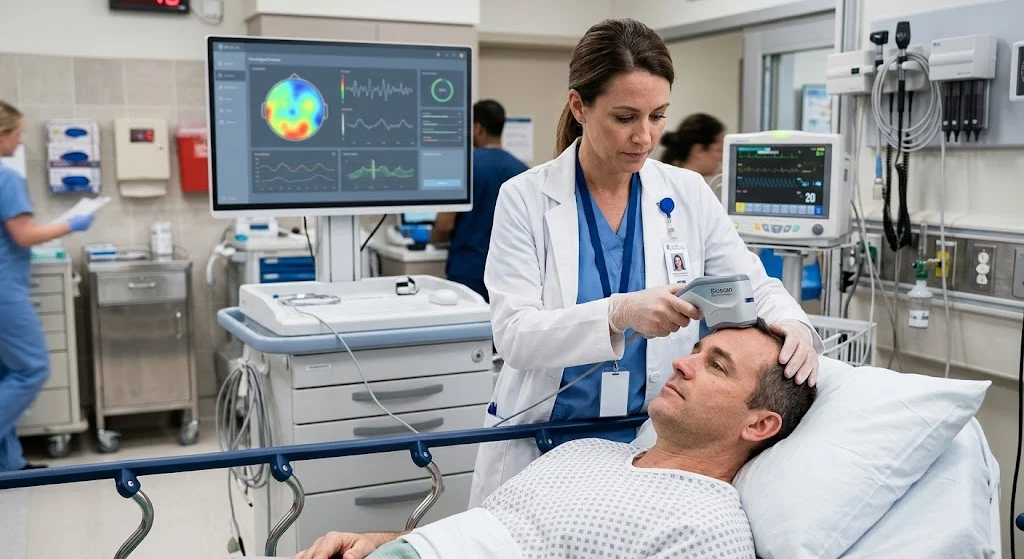
One relevant organization is Bioscan Research Private Limited, an Indian medtech company developing CEREBO®, a portable, non-invasive technology designed to help detect traumatic intracranial hemorrhage at the point of care. The company’s official materials describe CEREBO® as a near-infrared spectroscopy-based device intended for preliminary assessment and triage of traumatic brain injury patients. Bioscan Research provides its official product and research information.
Because several unrelated healthcare and technology organizations use the BioScan name, readers should verify the exact company, product, and medical application before relying on information found online. This guide focuses primarily on the medical-technology and diagnostic innovation context associated with Bioscan Research while examining the wider role of precision technology in modern healthcare.
Quick answer: Bioscan Med Technologies is best understood within the broader development of technology-assisted healthcare and diagnostics. Bioscan Research’s CEREBO® is designed to provide non-invasive, point-of-care screening for traumatic intracranial hemorrhage using near-infrared technology. The company states that CEREBO® does not replace CT scanning; instead, it is intended to support preliminary assessment and patient prioritization.
What Is Bioscan Med Technologies?
The term Bioscan Med Technologies suggests a healthcare technology organization or technology category centered on medical scanning, diagnostics, and technology-assisted patient assessment. However, the BioScan name is used by several organizations operating in different healthcare and technology fields.
For example, Bioscan Research Private Limited is an Indian healthcare technology company focused on traumatic brain injury detection. Its flagship CEREBO® system uses near-infrared spectroscopy and related optical technology to identify potential intracranial bleeding after head trauma.
Another organization, BioScan Diagnostics, describes itself as developing biomarker-based diagnostic testing solutions, while other companies using the BioScan name operate in healthcare assessment, laboratory diagnostics, or medical imaging. This makes accurate identification particularly important when researching products, clinical claims, or company information.
Why Medical Technology Matters in Modern Healthcare
Healthcare systems increasingly depend on technology to support diagnosis, monitoring, treatment planning, documentation, and clinical decision-making.
Traditional medical equipment remains essential, but newer technologies can sometimes complement existing systems by bringing assessment capabilities closer to the patient. Portable technologies are particularly relevant when patients are located in ambulances, emergency departments, remote clinics, sports facilities, disaster zones, or other environments where conventional imaging infrastructure may not be immediately available.
This is one of the ideas behind Bioscan Research’s CEREBO® technology. The company describes it as a portable, non-invasive device designed for point-of-care assessment of traumatic intracranial hemorrhage.
For broader technology context, readers can also explore Axel Technology SRL and modern technology solutions.
Understanding Bioscan Research and CEREBO®
Bioscan Research’s work provides a useful example of how medical engineering can combine optics, electronics, mechanics, and machine learning.
The company’s official website describes CEREBO® as an onsite intracranial hemorrhage detector that is fast, portable, and non-invasive. It is designed around near-infrared technology and is intended to help healthcare personnel assess trauma patients closer to the point of injury or initial medical contact.
The company’s FAQ explains that CEREBO® uses near-infrared light to examine brain tissue and an algorithm to analyze optical measurements for indications of intracranial bleeding.
What Is Traumatic Brain Injury?
Traumatic brain injury, commonly abbreviated as TBI, occurs when an external force causes injury to the brain. It can result from road accidents, falls, sports injuries, workplace incidents, violence, and other forms of trauma.
The severity of TBI can vary considerably. Some patients may have obvious neurological symptoms, while others can initially appear relatively well despite having an internal injury.
This creates a difficult challenge for emergency healthcare providers: determining which patients require urgent further evaluation and imaging.
Bioscan Research identifies this triage challenge as one of the problems its technology is intended to address.
How CEREBO® Works
CEREBO® is based on near-infrared spectroscopy, or NIRS. The company explains that the technology uses optical measurements to identify asymmetry associated with blood accumulation inside the skull.
In simplified terms, the device sends near-infrared light into tissue and analyzes how the light interacts with the tissues beneath the scalp. Because blood affects optical absorption, differences between measurements can provide information relevant to intracranial bleeding.
Bioscan Research states that its patented probe design, optical coupling methods, source-detector configuration, spot size, and laser power are part of the technology used to reach and analyze deeper brain tissue.
Why Point-of-Care Diagnostics Matter
Point-of-care testing means performing an assessment close to where the patient is located rather than requiring every diagnostic process to occur inside a centralized facility.
This approach can be particularly valuable when time, transportation, infrastructure, or specialist availability creates challenges.
For traumatic brain injury, early assessment can help clinicians determine which patients need additional investigation or urgent transfer. Bioscan Research positions CEREBO® as a tool that can contribute to this early triage process.
Point-of-care technology does not automatically replace conventional diagnostic methods. Instead, it can complement established clinical workflows when appropriately validated and used within its intended purpose.
Does CEREBO® Replace a CT Scan?
No. This distinction is important.
Bioscan Research explicitly states that CEREBO® is not intended to replace CT scanning. The company describes the device as a preliminary or adjunctive tool that can help prioritize patients and determine whether further imaging may be appropriate.
CT remains an important diagnostic imaging technology for evaluating suspected intracranial injuries. A portable screening device should therefore be understood as part of a broader clinical pathway rather than as a universal substitute for hospital-based imaging.
Potential Applications of Portable Medical Technology
Portable diagnostic technologies can have potential value in environments where conventional equipment is difficult to access.
Trauma Centers
Emergency departments and trauma centers may need rapid ways to prioritize patients after accidents or other injuries.
Ambulances
A portable assessment device may potentially provide additional information during emergency transport, depending on clinical protocols and regulatory authorization.
Remote Clinics
Remote healthcare facilities may not have immediate access to advanced imaging equipment. Point-of-care technology can potentially provide additional assessment capabilities while arrangements are made for further care.
Sports Medicine
Head impacts occur in contact and high-impact sports. Portable assessment tools may have applications in sports environments, although clinical decisions must remain under appropriate medical supervision.
Military and Disaster Response
Bioscan Research specifically identifies defense, disaster-management organizations, emergency evacuation vehicles, and other injury-prone environments among potential use settings for its technology.
Precision and Non-Invasive Healthcare Technology
One of the major trends in modern healthcare is the movement toward technologies that can provide useful information while reducing unnecessary discomfort or invasive procedures.
Non-invasive assessment can be valuable when repeated measurements are needed or when a patient’s condition makes conventional procedures more difficult.
CEREBO® is described by Bioscan Research as non-invasive and radiation-free. Its FAQ explains that the probes are placed gently on the scalp and that the measurement process does not require the head to be shaved.
These characteristics illustrate how engineering can influence the usability of medical technology as much as its underlying diagnostic concept.
The Role of Machine Learning in Medical Technology
Machine learning is increasingly used in healthcare research and technology development to identify patterns in complex datasets.
In the case of Bioscan Research, the company states that CEREBO® combines optical measurements with a proprietary algorithm to analyze the collected information. Its published research also includes work involving machine-learning-powered near-infrared spectroscopy for traumatic intracranial hematoma detection.
Machine learning should not be viewed as a replacement for clinical judgment. In healthcare, algorithmic outputs must be interpreted within validated clinical workflows and applicable regulatory requirements.
Research and Clinical Validation
Medical technology requires more than an interesting technical concept. Clinical validation, usability assessment, safety evaluation, regulatory compliance, and real-world performance all matter.
Bioscan Research maintains a publications section containing research related to CEREBO®, including work on portable NIRS-based detection of traumatic intracranial hematomas, human-factor engineering, and objective triage of TBI patients.
This research orientation is important because healthcare technology ultimately needs evidence that connects engineering performance with meaningful clinical use.
What Makes Medical Technology Precise?
The word “precision” can refer to several different characteristics in healthcare technology.
- Measurement quality: How consistently does the technology capture the intended signal?
- Repeatability: Can similar measurements be obtained under comparable conditions?
- Specificity: How well can the technology distinguish the target condition from other conditions?
- Sensitivity: How effectively can the system identify cases that are actually present?
- Usability: Can trained personnel operate the device correctly?
- Clinical relevance: Does the result contribute meaningfully to patient management?
A technology can be technically impressive while still requiring careful evaluation across all of these dimensions.
Bioscan Med Technologies and Preventive Healthcare
Modern medical technology is also moving toward earlier identification of potential health problems.
Earlier assessment can sometimes give healthcare professionals more time to investigate, monitor, or intervene. However, screening and diagnostic technologies must be used according to their intended purpose and supported by appropriate clinical follow-up.
This distinction is especially important with emerging technologies. A screening result is not necessarily a definitive diagnosis, and a negative screening result should not automatically override clinical symptoms or professional judgment.
How Portable Diagnostics Can Improve Healthcare Workflows
Healthcare organizations constantly balance clinical quality with time, staffing, infrastructure, and cost.
Portable technology may help by moving certain assessments closer to the patient. This can potentially reduce delays associated with transferring patients or waiting for access to centralized equipment.
For a technology to provide real workflow value, however, it must fit naturally into existing clinical procedures. Staff training, documentation, infection control, maintenance, data management, and referral pathways all need consideration.
For broader healthcare innovation, readers can also explore healthcare innovation and the future of medical technology.
Medical Technology and Remote Healthcare
Remote healthcare environments present unique challenges. Patients may live far from hospitals, transportation may take time, and specialist services may not be available locally.
Portable diagnostic systems can potentially provide healthcare workers with additional information before a patient reaches a larger medical facility.
Bioscan Research identifies community health centers, remote settings, and other point-of-care environments among the potential use cases for CEREBO®.
The actual value of such technology depends on local clinical protocols, availability of follow-up care, regulatory requirements, and the quality of the technology itself.
Healthcare Technology in Emergency Situations
Emergency medicine places particular importance on speed and prioritization.
When several patients arrive simultaneously, medical teams need reliable information to determine who requires immediate attention and which diagnostic resources should be prioritized.
Bioscan Research’s stated objective for CEREBO® is to provide an additional point-of-care assessment that can support triage of patients with traumatic brain injury.
It is important to emphasize that triage technology supports healthcare professionals rather than independently making treatment decisions.
Regulatory Considerations for Medical Technology
Healthcare technology operates in a highly regulated environment. A medical device may require specific approvals, registrations, quality controls, clinical evidence, and labeling depending on the country and intended use.
Businesses and healthcare organizations evaluating a medical technology product should verify its current regulatory status in the relevant jurisdiction rather than relying solely on promotional material.
They should also review the manufacturer’s intended use, contraindications, operating instructions, training requirements, maintenance procedures, and clinical evidence.
How Healthcare Organizations Should Evaluate Medical Technology
Healthcare organizations considering a technology solution should take a structured approach.
Clinical Need
First, identify the clinical problem the technology is supposed to solve. A device is valuable only when it addresses a meaningful healthcare need.
Evidence
Review published research, validation studies, performance data, and other relevant evidence.
Regulatory Status
Confirm whether the product is authorized for its intended use in the jurisdiction where it will operate.
Usability
Consider whether healthcare personnel can learn and operate the system reliably.
Integration
Determine how the technology fits into existing clinical workflows, records, referral pathways, and diagnostic procedures.
Total Cost
Consider purchase costs as well as consumables, maintenance, training, software, calibration, and support.
Bioscan Med Technologies and the Future of Healthcare
The future of healthcare technology is likely to involve greater integration between sensors, portable devices, artificial intelligence, medical imaging, electronic records, and clinical decision support.
The objective is not simply to produce more technology. The goal is to make useful clinical information available at the right time and in the right setting.
Portable technologies such as CEREBO® demonstrate one possible direction: bringing a specialized assessment closer to the patient instead of requiring every diagnostic process to begin in a centralized imaging department.
For another perspective on technology-driven innovation, see SY Metal Technology Group and industrial innovation.
Challenges Facing Medical Technology Innovation
Developing innovative medical technology is complex. Engineering performance is only one part of the process.
- Clinical validation can require substantial time and resources.
- Regulatory requirements vary between markets.
- Healthcare workers require training.
- Hospitals need reliable technical support.
- Data security becomes increasingly important as systems become connected.
- Procurement decisions must consider long-term costs.
- Technology must integrate with existing clinical workflows.
- Patients and clinicians need clear explanations of what a technology can and cannot do.
These challenges explain why responsible medical innovation requires cooperation between engineers, clinicians, researchers, regulators, and healthcare organizations.
Why Transparency Matters in Healthcare Technology
Healthcare technology companies operate in a field where marketing claims can directly influence patient and clinical decisions.
For that reason, transparency about intended use, limitations, validation, regulatory status, and appropriate clinical application is essential.
Bioscan Research provides an example of this distinction through its explicit statement that CEREBO® does not replace CT scans.
That kind of limitation is important for readers because it prevents a screening tool from being misunderstood as a universal diagnostic replacement.
Frequently Asked Questions About Bioscan Med Technologies
What is Bioscan Med Technologies?
Bioscan Med Technologies refers broadly to medical technology associated with scanning, diagnostics, health assessment, and technology-enabled healthcare. Because several organizations use the BioScan name, the exact company should always be verified before evaluating a specific product.
What is Bioscan Research?
Bioscan Research Private Limited is an Indian medtech company developing technology for traumatic brain injury assessment. Its flagship CEREBO® system is designed for non-invasive detection of intracranial hemorrhage at the point of care.
What is CEREBO®?
Does CEREBO® use radiation?
Bioscan Research states that CEREBO® uses near-infrared optical technology rather than ionizing radiation.
Can CEREBO® replace a CT scan?
No. Bioscan Research explicitly states that CEREBO® is not intended to replace CT scanning. It is positioned as a preliminary or adjunctive assessment tool for trauma patients.
Where can CEREBO® potentially be used?
Bioscan Research identifies trauma centers, ambulances, emergency wards, disaster-management organizations, emergency evacuation vehicles, independent clinics, community health centers, defense environments, and sports settings among potential use cases.
Does Bioscan Research publish scientific research?
Yes. The company maintains a publications section containing research related to CEREBO®, near-infrared spectroscopy, traumatic intracranial hematoma detection, machine learning, and human-factor engineering.
Is Bioscan Med Technologies the same as every company called BioScan?
No. Several unrelated companies use BioScan or Bioscan in their names. Healthcare organizations and consumers should verify the official company website, product name, address, and regulatory information before assuming that two BioScan-branded organizations are connected.
Final Thoughts
Bioscan Med Technologies reflects the broader movement toward more portable, connected, and technology-assisted healthcare. Bioscan Research’s CEREBO® provides a concrete example of this direction by combining near-infrared spectroscopy, optical engineering, electronics, mechanics, and machine-learning-based analysis for point-of-care assessment of traumatic intracranial hemorrhage.
The technology is particularly interesting because it addresses a practical healthcare challenge: providing additional information closer to the point of injury or initial medical assessment. At the same time, its role should be understood correctly. Bioscan Research states that CEREBO® does not replace CT scanning and is intended to support preliminary assessment and triage.
As medical technology continues to evolve, the strongest innovations will be those that combine technical performance with clinical evidence, regulatory compliance, usability, affordability, and seamless integration into real healthcare workflows.
For more technology-focused reading, continue with Axel Technology SRL, FSTONE Technologies, and technology-driven growth at Timnath.